Tree roots in pipes: who is responsible, what to plant and what a plumber does
Tree roots get into drain pipes through small cracks. In Sydney Water's area the pipe from your home to the utility's connection is yours, roots included, so clearing them is a job for a licensed plumber and preventing them comes down to choosing and placing trees with your pipes in mind.
Published 6 October 2026 · Reading time approx. 8 min
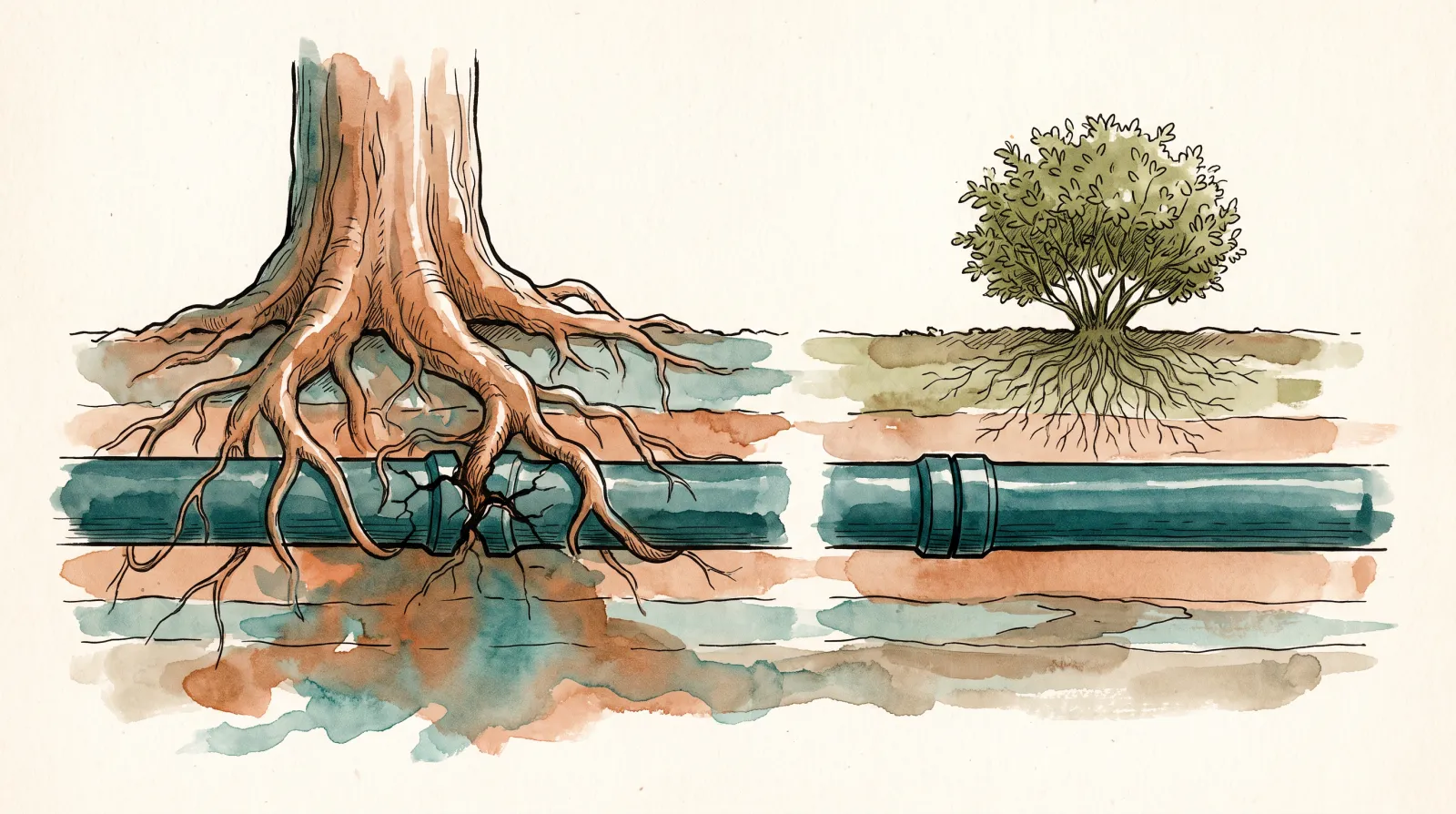
If tree roots are in your drain, the pipe they found is probably yours to fix. In Sydney Water's area, you are responsible for wastewater pipes from your property up to where they connect to the utility's network. Sydney Water also says you need a licensed plumber to clear a blockage.
The cheaper fix is the one you make with a spade, years earlier. That means the right tree, planted far enough from the pipe.
This guide from Earth Plumbing covers who pays, the exceptions that shift the bill, the trees one utility says to avoid, and what to do when roots are already in.
Tree roots in pipes: who is responsible?
Property owner (Sydney Water rule)
- Kitchen sink and toilet
- House drain
- Private sewer pipe under the backyard, past a large tree: roots in a small crack
- Point of connection and the roots at the junction
- More than 2.5 m deep and excavation needed: utility takes over the repair
- Sydney Water: avoid planting trees within 6 m of wastewater pipes
Source: Sydney Water
Start with where your pipe meets the utility's. Under Sydney Water's rules, the utility owns the junction, but the property owner is responsible for their connection, which it calls the point of connection.
That line decides most root jobs. The same page says the owner must clear any tree roots that enter the junction at the point of connection. The owner is also responsible for damage to the junction or junction collar caused by tree roots or excavation.
The council or water utility does not always fix a blocked sewer. In Sydney Water's area, Sydney Water is responsible for the pipes that form its network, and the property owner for everything up to where their pipes connect to it.
Melbourne Water's planting guideline is just as direct about the plants themselves: "You are responsible for any damage plants cause to nearby buildings, footpaths, underground pipes and other structures."
The exceptions that move the bill
Sydney Water carves out three cases.
- Damage during root removal. If the junction was damaged by work to remove roots from the point of connection, Sydney Water's crew checks the junction, and if it accepts responsibility it pays to repair or replace it. It calls this a "takeover".
- Deep connections. If a point of connection is more than 2.5 metres deep and excavation is needed, the utility takes over the repair. It does not reimburse excavation to 2.5 m or work on the private service.
- Collapsed pipes under public land. Sydney Water may repair private collapsed wastewater pipes under a public footpath or road as a free service to residential customers, once a licensed plumber confirms excavating the road or footpath is the only way.
| Situation | Who is responsible (Sydney Water) | What has to happen |
|---|---|---|
| Roots in your private wastewater pipe | Property owner | Licensed plumber clears it. |
| Roots entering the junction at the point of connection | Property owner | Owner must clear them. |
| Junction or junction collar damaged by tree roots or excavation | Property owner | Owner responsible for the damage. |
| Junction damaged by work to remove roots from the point of connection | Sydney Water, if it accepts responsibility | Its crew checks the junction; if accepted, it pays to repair or replace ("takeover"). |
| Point of connection more than 2.5 m deep and excavation needed | Sydney Water takes over the repair | No reimbursement for excavation to 2.5 m or work on the private service. |
| Private collapsed pipe under a public footpath or road, residential customer | Sydney Water may repair as a free service | A licensed plumber must confirm excavating the road or footpath is the only way. |
Source: Sydney Water
Check your own utility's rules.
Outside Sydney Water's area, ring your own water utility before you assume who pays. We covered the wider question of pipe ownership in our blocked drains guide.
How tree roots get into drain pipes
Roots are not breaking in for sport. Sydney Water says tree roots can enter small cracks in wastewater pipes to seek out nutrients. Melbourne Water adds that roots often extend into stormwater, sewage and water pipes in search of food and nutrients.
Roots are not only a problem for old pipes, because they enter through small cracks, so a crack near moisture matters more than the pipe's age alone.
Ground movement, root pressure and ageing materials all open those cracks. Our cracked pipes guide walks through what breaks a pipe in the first place.
Signs of tree roots blocking a drain
From a small crack to a blockage
- Small crack in a wastewater pipe
- Roots enter, seeking nutrients
- Roots keep growing and take up space
- Drainage slows: the early sign you can notice Call a licensed plumber here
- Blockage
Source: Sydney Water
The sequence is simple. Once inside, roots keep growing, take up space and slow drainage, which can cause a blockage.
So the sign you can actually notice is a drain that empties more slowly than it used to. A full blockage is the end of that road, not the start. Melbourne Water notes roots can cause blockages, overflows and flooding.
A slow drain under or near a big tree is worth a plumber's look before it becomes an overflow. Our blocked drains guide and our piece on routine drain inspection cover what that check involves.
How far from pipes should you plant trees?
Two utilities' own guidance, not a national rule.
- Sydney Water: suggested distance from wastewater pipes, 6 m.
- Melbourne Water: mature canopy and roots from the edge of its drains, sewers and water mains, at least 5 m.
Source: Sydney Water; Melbourne Water
There is no single national number. Two utilities publish their own.
Sydney Water says to avoid planting trees within 6 metres of wastewater pipes.
Melbourne Water asks for trees and shrubs to be planted so the mature canopy and roots are at least 5 m from the edge of its drains, sewers and water mains. That is a rule for its own assets, not a household minimum. Its guideline also notes vegetation can block access to maintenance holes and vent pipes.
Our view: if your utility publishes no distance, treat both numbers as a sign of scale. In a narrow suburban yard, several metres from the pipe run rules out a large tree near it altogether.
Which trees to avoid planting near pipes
| Group | Trees |
|---|---|
| Natives | bottlebrush; casuarinas/she-oaks; large gum trees (Eucalyptus); brush box; paperbarks (Melaleuca) |
| Figs | Moreton Bay fig; weeping fig; rubber tree |
| Flowering and ornamental | jacaranda; crepe myrtle; oleander; orange jasmine; large magnolias |
| Shade and deciduous | camphor laurel; liquidambar; large maples |
| Fruit | mulberry; avocado |
| Grasses | bamboo |
A Sydney Water list. Your local nursery can advise on root systems.
Sydney Water says some trees are more likely to cause problems and publishes an "avoid planting" list. It includes bamboo, bottlebrush, casuarinas, camphor laurel, large gum trees, figs, jacaranda, crepe myrtle and liquidambar, along with brush box, paperbarks, mulberry, oleander, orange jasmine, avocado and large maples and magnolias.
Notice how many favourite Australian garden trees are on it. Bottlebrush, paperbarks and big gums are natives, which surprises people who assume "native" means "safe near pipes".
It is Sydney Water's list, not a national one. Sydney Water also says your local nursery can advise on root systems, and that advice applies anywhere.
How to stop tree roots getting into pipes
Five ticks before planting
Source: Sydney Water; Melbourne Water
Prevention is the greenest plumbing there is. Nothing gets dug up, replaced or sent to landfill.
- Know where your pipes run. Sydney Water customers can get a sewerage service diagram online via Tap in®. Elsewhere, ask your utility or council what records exist.
- Pick the plant for its roots. Melbourne Water says you can avoid damage by choosing plants with suitable root systems and planting a suitable distance from assets.
- Use a root barrier. A root barrier is a tough liner wrapped around the plant's base at planting that restricts root growth.
- Plant for the tree it will become. Melbourne Water's advice is to plant with future growth in mind. The sapling you buy is not the tree your pipes will meet.
On reactive clay, trees and pipes affect each other. Queensland's building regulator lists corrective action for cracking on these sites that may include regrading surface drainage, moving gardens and trees or repairing leaks in ... sewer drainage.
Fewer cracks means fewer leaks, which matters for water use too. See how to reduce water usage at home.
How to get rid of tree roots in a drain
Clearing roots from a wastewater pipe is not a weekend job. Sydney Water says you need a licensed plumber to clear a blockage.
The rule is not just Sydney's. In NSW, plumbing, draining and gasfitting work needs the right licence or certificate. In Queensland, "most plumbing work undertaken in Queensland is regulated and requires a QBCC licensed plumber or drainer".
If the tree is staying, clearing once rarely ends it. Sydney Water says that where existing trees are a problem, a plumber can set up a regular maintenance plan. Ask about one when the plumber visits.
If the roots got in through a pipe that is now broken, the conversation turns to repair. Our broken and burst pipes guide explains the options to discuss.
When the tree is next door, or you want it gone
Check the rules before anyone picks up a saw. In NSW, the Land and Environment Court says that before you prune or remove a tree you must apply to the local council for a permit or development approval. Exemptions depend on the work, species, type and condition of the tree, and bushfire-prone land has different requirements.
If the roots come from a neighbour's tree, NSW has a legal route. Under the Trees (Disputes Between Neighbours) Act 2006, the court can order payment for repairing or replacing sewer pipes damaged by roots, and payment for a root control barrier. The court recommends expert evidence (arborists, builders, engineers) of the cause and cost of damage.
A plumber's report on where the roots entered your pipe is the kind of record that helps. Outside NSW, check your own council and state rules first.
Tree roots in pipes at a glance
Source: Sydney Water; Melbourne Water
- Owner: wastewater pipes from your property up to where they connect (Sydney Water).
- Roots at the point of connection: the owner must clear them.
- Clearing: a licensed plumber.
- Planting distance: 6 metres from wastewater pipes (Sydney Water); at least 5 m from its drains, sewers and water mains (Melbourne Water).
- Deep connections: more than 2.5 metres deep with excavation needed, and Sydney Water takes over the repair.
Getting help with roots in your drain
If a drain near a big tree has slowed down, have a licensed plumber inspect it now rather than after it overflows. If you are planning a garden, find your pipes before you buy the tree.
Not sure which applies to you, or what to ask the plumber? Send Earth Plumbing your question through our Ask a Question page, or use the enquiry form below this article.
Sources
- https://www.sydneywater.com.au/plumbing-building-developing/plumbing/wastewater-blockages.html
- https://www.sydneywater.com.au/plumbing-building-developing/plumbing/wastewater-blockages/guide-licensed-plumbers/responsibility-repairs.html
- https://www.melbournewater.com.au/building-and-works/work-or-build-near-our-assets-or-easements/planting-guidelines
- https://lec.nsw.gov.au/your-legal-problem-is-about---/trees-and-hedges.html
- https://www.nsw.gov.au/business-and-economy/licences-and-credentials/building-and-trade-licences-and-registrations/plumbing-draining-and-gasfitting
- https://www.qbcc.qld.gov.au/news/unregulated-plumbing-guide
- https://www.qbcc.qld.gov.au/sites/default/files/2021-10/guide-preventing-structural-damage.pdf
Pictures in this guide are illustrations, not photos of our jobs.
Tell us what your plumbing is doing
Describe the symptom, the fixture and how long it has been going on. We read every enquiry and reply with guidance and a sensible next step. Anything that needs tools is a licensed plumber's job, and we will say so plainly.