Industrial plumbing: the water in, the waste out, and who is responsible for both
Industrial plumbing is not domestic plumbing at a bigger scale. It moves process water, runs hot and under pressure, and carries away effluent that is not ordinary sewage, all under a compliance load that sits with the site's owner, not only the plumber. This guide explains how the systems work, where they fail, what a facilities manager can genuinely manage, and the point where the job belongs to a licensed plumber or a specialist.
Updated 16 July 2026 · Reading time approx. 16 min
01 What makes plumbing industrial
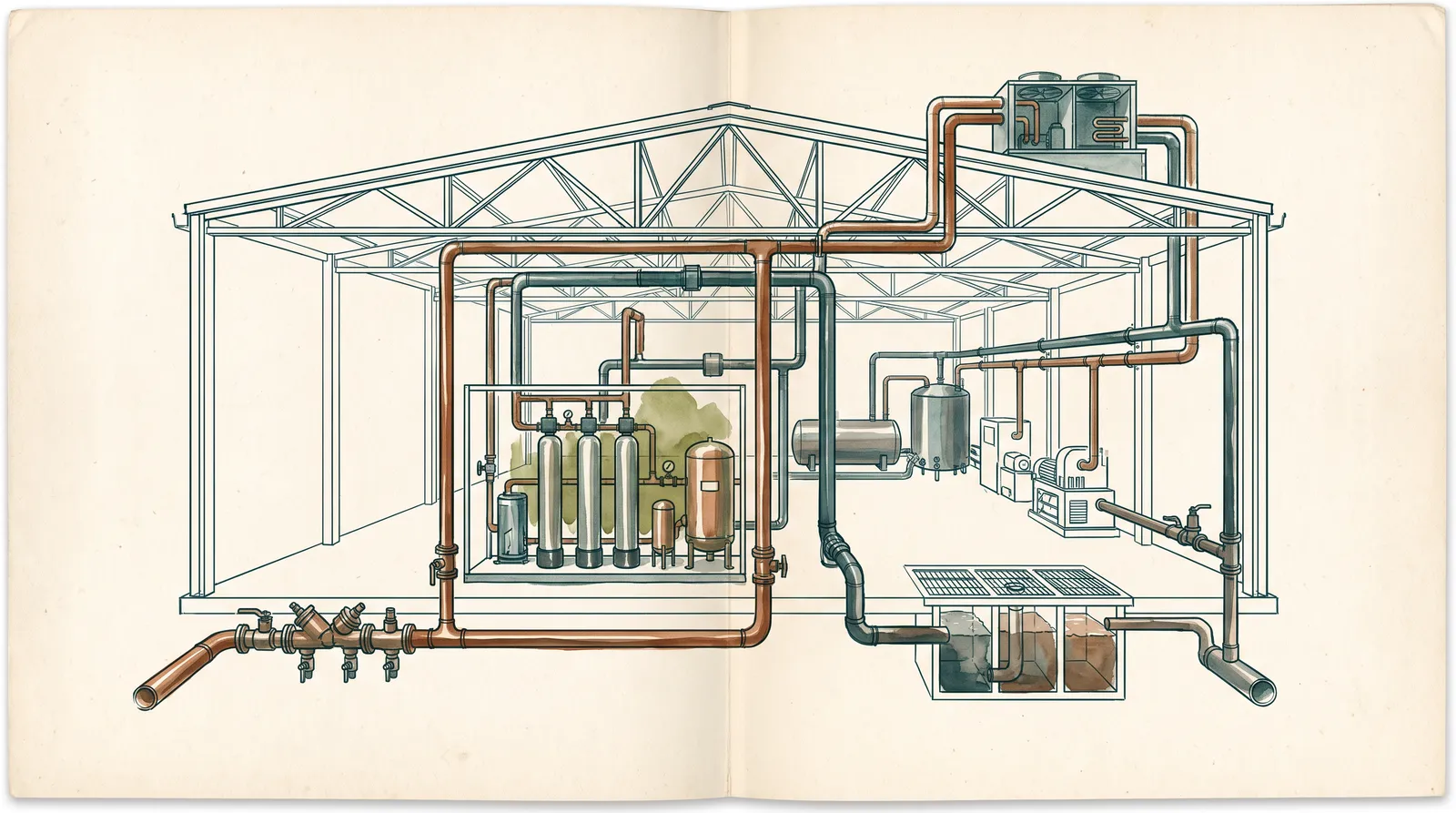
A house takes in drinking water and sends out sewage, and both are well understood quantities. A factory, workshop, laundry, food plant or treatment works does something harder: it takes water in, changes it (heats it, pressurises it, mixes chemicals or product into it, runs it through machines), and then has to get rid of whatever it has become. Four things change once you cross that line, and every section below follows from them.
The water is put to work, not just used. Process water might be softened, filtered, chilled, boiled or dosed before a machine will accept it, and it leaves carrying heat, solids, fats, metals or chemicals it did not arrive with.
The duty is continuous. A domestic pipe sees a few minutes of flow an hour. An industrial line can run at temperature and pressure all shift, every shift, and materials that shrug off intermittent use fatigue and corrode under constant load.
The effluent is not ordinary sewage. Anything other than normal domestic wastewater is trade waste, and you cannot simply put it down the sewer. It has to be pre-treated to an agreed standard and discharged under an agreement with your water authority (section 05).
The compliance load sits with the occupier. A plumber installs and certifies the pipework, but the ongoing obligations, the trade-waste agreement, the backflow test records, the cooling-tower register, the environment licence, belong to the business that runs the site. Not knowing that is the single most expensive mistake in this guide.
The facts panel
- Governing plumbing framework
- AS/NZS 3500 via the PCA
- Non-domestic discharge to sewer
- trade waste agreement
- Cooling tower / warm water
- AS/NZS 3666
- Higher-risk premises may need
- an EPA licence
- Tank or pit entry
- confined-space work
- All pipework is
- licensed work
The Plumbing Code of Australia (PCA) applies the AS/NZS 3500 series nationally; trade waste, cooling towers and environment licences are administered by state authorities. See sources below.
02 The water coming in
Every industrial site draws from the same town main as the houses around it, and the water authority has one non-negotiable concern about that connection: nothing that happens on your site can ever get back into the public supply. That risk is real on industrial sites in a way it never is at home.
Backflow, and why it is taken so seriously. If pressure in the main drops (a burst nearby, heavy draw at a hydrant), water can be pulled backwards through your pipework. On a site where the pipework connects to chemical dosing tanks, process vessels, cooling systems or a wash bay, that back-siphoned water can carry contaminants straight into the drinking supply. The defence is a testable backflow prevention device sized to the hazard, installed at the boundary. On medium and high-hazard connections it must be tested by an accredited person and the result recorded, typically every year. That test record is the site's to keep, not the plumber's.
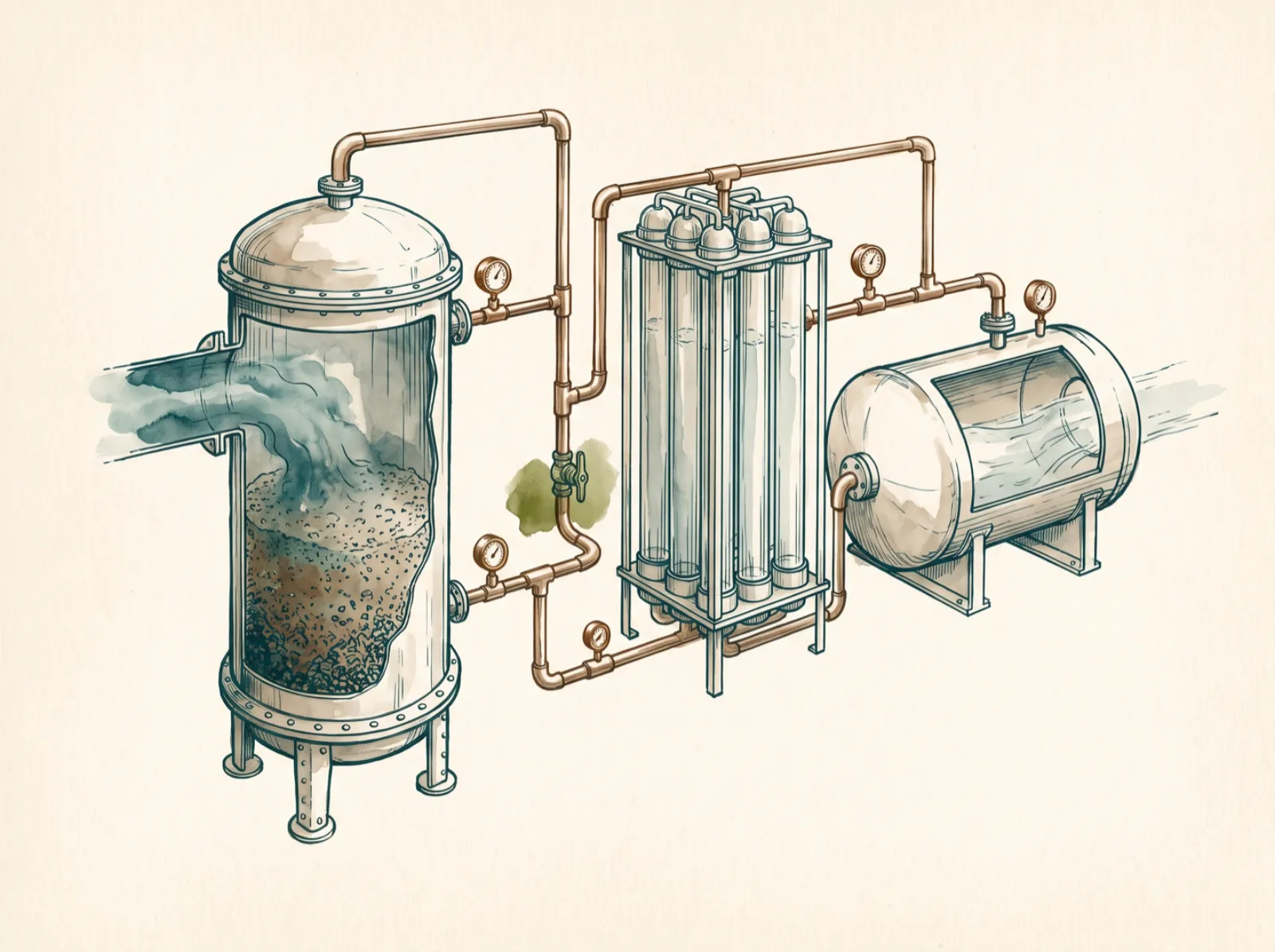
Treating the water for the process. Raw town water is fine for drinking and rarely fine for a machine. Depending on the process it may need:
- Filtration to strip suspended solids, from a coarse self-cleaning strainer down to fine media filters.
- Softening or dealkalisation to pull out the calcium and magnesium that scale up boilers, heat exchangers and membranes.
- Membrane treatment where the process needs genuinely pure water: ultrafiltration for fine particles and microbes, then reverse osmosis for dissolved salts, run in sequence so the coarse stages protect the expensive one.
The rule of thumb that saves the most money is simple: put the cheap, robust treatment first so the fragile, expensive treatment lasts. An RO membrane fed unfiltered water fouls in weeks.
03 Pressure, heat and the pipes
Industrial lines carry more energy than domestic ones, and that energy is what eventually finds any weakness in the system. Three forces do most of the damage.
Pressure. Higher working pressures mean thicker pipe walls, rated fittings and, on genuine high-pressure or pressure-vessel systems, equipment that falls under separate pressure-equipment rules rather than ordinary plumbing. Pressure is also not constant: a pump starting, a valve slamming shut, or a process cycling can spike the line well above its steady figure.
Water hammer, scaled up. When fast-moving water is stopped suddenly by a quick-closing valve, its momentum has nowhere to go and slams through the pipework as a pressure wave. In a house that is an annoying bang. On an industrial line carrying more mass at more speed, the same wave cracks fittings, splits gauges and fatigues joints. It is managed with slow-closing valves, air chambers or arrestors, and proper pipe support, not by hoping the pipe holds.
Temperature. Hot process lines expand, and a long steel run can grow by a surprising amount between cold and working temperature. Held rigid, that movement tears at anchors and joints; the fix is expansion loops and sliding supports designed in from the start. Heat also drives corrosion and lowers the pressure a material can safely hold, so a line that is fine cold can be marginal hot.
A gauge reading that has crept up over months, a support that has started to weep rust, a line that ticks or knocks on start-up: none of these is an emergency today, and all of them are the system telling you where it will fail first. A simple logbook of pressures and temperatures turns "it just went" into "we saw that coming".
04 Corrosion, the slow failure that sets your budget
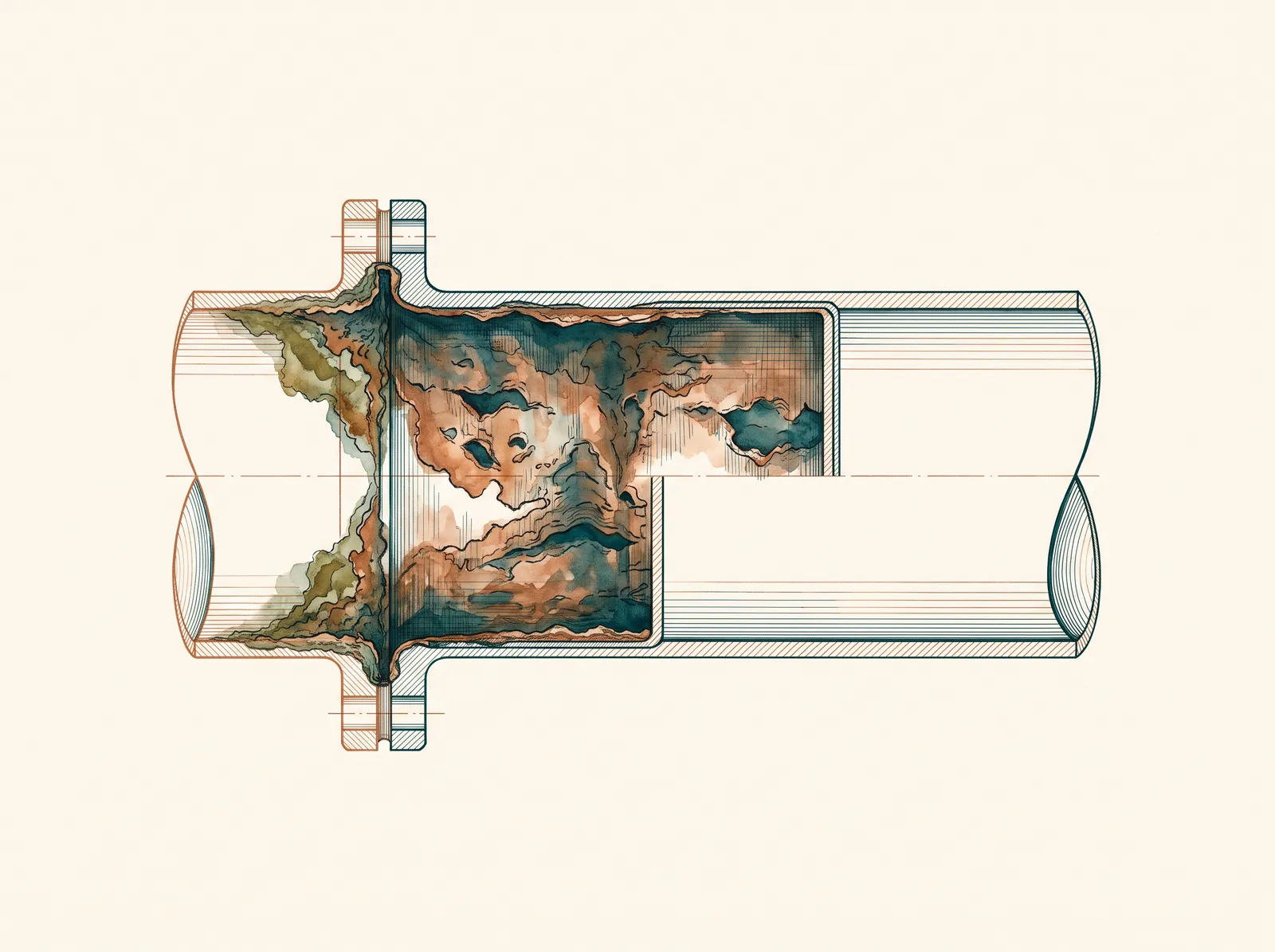
Most industrial pipe does not fail in a dramatic burst. It corrodes, quietly, from the inside, and the first you know of it is a weep, a pressure drop or a stain. Knowing which mechanism you have is what turns replacement from a surprise into a plan.
Galvanic corrosion. Join two dissimilar metals (copper to steel, for instance) in the presence of water and you have made a battery. The less noble metal corrodes preferentially at the junction. It is why material transitions need the right dielectric fittings, and why a well-meant repair in the wrong metal can eat a joint within a season.
Pitting and crevice corrosion. Localised attack that drills narrow holes rather than thinning the whole wall. It hides under deposits and in stagnant crevices, and a pipe can look sound from outside while a pit has almost breached it.
Erosion-corrosion. Fast or turbulent flow, especially with any grit in it, strips the protective film off the metal and lets corrosion restart continuously. It shows up at elbows, valves and anywhere the flow changes direction.
Microbially influenced corrosion. Bacteria in low-flow or stagnant water form colonies that corrode the metal beneath them. Dead legs and rarely-used lines are the classic sites.
The water itself sets the pace. Low pH, high temperature, dissolved oxygen and chlorides all accelerate the reactions, which is why the treatment choices in section 02 are also corrosion decisions. Where corrosion cannot be designed out, it is managed: correct material selection, protective linings and coatings, cathodic protection on buried and immersed metalwork, and regular wall-thickness checks so a line is replaced on evidence rather than after a failure.
05 The waste going out
This is the section that catches sites out, so it is worth stating plainly: the sewer is only licensed to receive ordinary domestic sewage. Anything else, water carrying fats, oils, food solids, silt, metals, chemicals, heat or strong pH, is trade waste, and discharging it needs written approval from your water authority before it goes down the drain.
A trade-waste agreement sets acceptance limits for what your discharge may contain and usually requires the waste to be pre-treated on site to meet them. The common pre-treatment devices each do one job:
- Grease arrestors hold wastewater long enough for fats and oils to float and solids to settle, so only the middle layer leaves. Kitchens and food processing need them, sized to the load and pumped out on a schedule.
- Oil and silt separators do the same job for wash bays, workshops and yards, catching hydrocarbons and sediment before the sewer or stormwater.
- pH correction and cooling bring strongly acidic, alkaline or hot discharges back inside the agreed window.
Pre-treatment only works if it is maintained. A grease arrestor that is never pumped out stops arresting grease and starts passing it straight through, and the first evidence is often a blocked sewer and a non-compliance notice arriving together.
06 Compliance, and the cost of getting it wrong
On an industrial site the regulations are not paperwork around the plumbing. They are the reason several of the systems exist, and the penalties for ignoring them fall on the business, not the contractor. Four obligations matter most, and each is administered by a different authority.
Water pollution
Letting trade waste or a spill reach a drain, creek or the ground can be an offence in its own right. Environmental penalties are among the heaviest a business faces, and "the drain took it" is not a defence.
Legionella
A neglected cooling tower or warm-water system can grow and aerosolise Legionella. Outbreaks have been traced to exactly this, which is why these systems are registered and tested under public-health rules.
Backflow
A missing or failed backflow device puts the public water supply at risk, which is why the annual test is mandatory and the record is audited.
Confined spaces
Pits, tanks and pump wells can hold or generate dangerous atmospheres. Entering one without the right procedure is a genuine fatality risk, not a formality.
Discharge and pollution. Beyond the trade-waste agreement, larger or higher-risk premises hold an environment protection licence that sets conditions on what the site may discharge and emit. In New South Wales this runs under the Protection of the Environment Operations Act 1997, administered by the EPA; every state and territory has an equivalent regulator and law. Polluting waters can be an offence whether or not a licence exists.
Cooling towers and warm-water systems. Where a site runs a cooling tower or a warm-water system, it becomes a Legionella risk that is managed under AS/NZS 3666 and state public-health regulation. In NSW that means the system is registered with the local council, has a risk-management plan, and is sampled and tested on a set schedule, with high results reported quickly. This is specialist water-treatment territory, not general plumbing.
Work health and safety. Much industrial plumbing work happens in confined spaces or around hazardous chemicals, both of which carry their own WHS duties. For the site occupier the practical point is that this work needs trained, permitted people and a plan, and that is exactly why parts of it are never a do-it-yourself job.
If your site treats, heats, cools or contaminates water, assume you carry obligations under at least a water authority and an environmental regulator, and possibly a public-health one as well. The cheapest time to find out which is before an inspection, not during one. A licensed plumber and your water authority can tell you what applies to your specific site.
07 Keeping it running, and who does what
Industrial water systems reward attention and punish neglect, and most of the attention they need is not plumbing at all. It is housekeeping, record-keeping and watching for change, and every bit of it is the site's own to do. The line between what you can manage and what needs a licensed plumber or specialist is clearer here than anywhere else in plumbing, because on an industrial site there is no grey middle where a confident amateur can help. It is either housekeeping or it is licensed work.
Where the line is drawn
Everything on the left keeps the system honest and belongs to the site. Everything on the right is licensed or accredited work by law, and a competent contractor is the only right answer.
Yours to manage In-house
- Housekeeping: strainers cleared, spill kits stocked, bunding intact, arrestors and pits kept accessible.
- Reading meters and logging pressures, temperatures and water use so you can see change early.
- Keeping the asset register and the service and test schedule up to date.
- Booking the mandatory jobs on time: backflow tests, arrestor pump-outs, cooling-tower sampling.
- First response to a leak or spill: isolate, contain, and notify the authority. Plan and rehearse it in advance.
- Holding the compliance records: agreements, test certificates, licence conditions.
Needs a licensed plumber or specialist By law
- Any pipework, fixtures, water heaters and all gas work.
- Backflow prevention device testing, by an accredited tester.
- Designing and sizing trade-waste pre-treatment, with the water authority's approval.
- Entry to any confined space: a tank, pit or pump well.
- Cooling-tower and warm-water treatment and testing, under AS/NZS 3666.
- Anything that changes what the site discharges, which may need the EPA as well.
Predictive maintenance, honestly. Sensors that watch pressure, flow, temperature and vibration and flag a trend before a failure are genuinely useful on a system that runs continuously, because the earliest sign of most industrial failures is a slow drift in a number no one is reading. The caution is the same as anywhere: a dashboard is only worth what someone does with its alerts. The value is in the response plan behind the sensor, not the sensor itself.
08 Water worth saving
High-volume sites have the most to gain from using less, because on an industrial scale water is rarely just water: it has been pumped, treated, heated or chilled, and every litre saved saves that energy too. The moves that actually pay back, rather than the ones that only look green:
- Find the leaks first. On a large site a continuous leak can run unseen for months. Sub-metering the big users and watching overnight flow (which should fall to near zero) finds them faster than any upgrade.
- Reuse where the quality allows. Rinse water, cooling blowdown and treated effluent can often be recovered for a lower-grade use rather than sent to drain, provided the reuse is properly separated from the drinking supply with the same backflow discipline as section 02.
- Close the loop on cooling. Recirculating cooling instead of single-pass can cut a site's water use dramatically, with the trade-off that the recirculating loop then needs the Legionella management of section 06.
- Specify efficient fixtures in the amenities. The washrooms and kitchens on an industrial site are ordinary plumbing, and choosing WELS-rated tapware, toilets and urinals there is the same easy win it is anywhere. The star rating is a national scheme; more stars is less water for the same job.
09 When it is a licensed plumber's job
On an industrial site the answer to "should I get a professional in" is nearly always yes, because almost everything past housekeeping is licensed or accredited work by law. The more useful question is how to tell a contractor who understands industrial systems from one who does good domestic work and is out of their depth. Ask them:
- How will you protect the town main? A serious answer talks about the hazard rating of your site and the right class of testable backflow device, not just "a non-return valve".
- What does our trade-waste agreement allow, and does this change it? A contractor who works on industrial sites will ask about your agreement before they touch the discharge side, because changing it without the authority is their licence on the line as well as your compliance.
- What is the failure mode, and how will we see it coming? The best industrial work ends with you knowing what will wear out next and what to monitor, so a failure becomes a scheduled replacement.
Good industrial plumbing is quiet: it keeps clean water clean, gets used water safely away inside the rules, and leaves you with records and a maintenance plan rather than a recurring emergency. If you can describe the system you have and the problem you are seeing, the enquiry desk below can help you work out what you are actually looking at and what kind of licensed help it needs.
For the everyday commercial side of a mixed site, the amenities, kitchens, hot water and drainage that behave like a bigger version of a home, our commercial plumbing guide covers the ground this one leaves out, and the sustainable plumbing guide covers the water-efficiency thinking behind it.
10 Questions, answered
Can we put our process wastewater down the normal sewer?
Not without approval. The sewer is licensed to take ordinary domestic sewage; anything carrying fats, oils, solids, chemicals, metals, heat or strong pH is trade waste, and it needs a written agreement with your water authority first, almost always with on-site pre-treatment to meet the agreed limits. Discharging trade waste without that agreement is a compliance breach and, if it pollutes waters, can be a separate environmental offence.
Who is responsible for the backflow test, us or the plumber?
Both, in different ways. An accredited person must do the actual test, usually every year on a medium or high-hazard device. But the obligation to have it tested, and to keep and produce the record, sits with the site occupier. If the test lapses, it is the business, not the tester, that is out of compliance.
Why does a cooling tower need so much attention?
Because it combines warm water, nutrients and a fine spray, which is the ideal way to grow and then aerosolise Legionella bacteria. That is a genuine public-health risk with a history of outbreaks, so cooling towers and warm-water systems are registered, run to a risk-management plan, and sampled and tested on a schedule under AS/NZS 3666 and state public-health rules. It is specialist water-treatment work, not something to manage informally.
Our pipes are old but not leaking. Can we wait until they do?
You can, but on a continuously loaded system it is usually the expensive choice. Corrosion works from the inside, so a line can look sound while a pit has nearly breached the wall, and a failure at temperature or pressure can take the process down and make a mess at once. Wall-thickness checks let you replace pipe on evidence, during planned downtime, rather than at 2am on a broken line.
Do we need an environmental licence?
It depends on what you do and at what scale. Many larger or higher-risk premises hold an environment protection licence that sets conditions on discharges and emissions; smaller sites may sit under general environmental duties and their trade-waste agreement instead. Either way, polluting waters can be an offence with or without a licence. Your state environmental regulator can tell you which category your site falls into, and it is worth asking before you are asked.
Is any industrial plumbing safe to do ourselves?
The plumbing itself, no. All pipework, water heaters, gas and backflow testing are licensed or accredited work by law. What is genuinely yours to do is everything around it: housekeeping, reading meters, logging pressures and temperatures, keeping the asset register and test schedule, and planning your first response to a spill. That work is not optional, and doing it well is what keeps the licensed jobs planned rather than urgent.
Sources
- Plumbing Code of Australia, Australian Building Codes Board. The national framework through which the AS/NZS 3500 plumbing and drainage series (including the provisions this guide refers to) applies. The standards themselves are published by Standards Australia and are paywalled; the ABCB page describes their role and scope.
- Industrial trade wastewater, Sydney Water. A representative water authority's explanation of what trade waste is and why discharging it needs an agreement and pre-treatment. Every state and metropolitan water utility runs its own equivalent scheme; check your own authority for local limits.
- Environment protection licences and water pollution, NSW Environment Protection Authority. The NSW instance of environmental licensing and the water-pollution offence provisions under the Protection of the Environment Operations Act 1997. Each state and territory has an equivalent regulator and law.
- Legionella control, NSW Health. The regulation of cooling towers and warm-water systems, applying AS/NZS 3666 and the Public Health Regulation, including registration, risk-management plans and scheduled testing. Other states regulate these systems under their own public-health laws.
- Model Code of Practice: Confined spaces, Safe Work Australia. The national model guidance on the health and safety duties that apply to work in confined spaces such as tanks, pits and pump wells, given effect through each jurisdiction's Work Health and Safety laws.
- Water Rating (WELS), the Australian Government's Water Efficiency Labelling and Standards scheme. The national star-rating scheme referenced for the amenity fixtures in section 08.
Tell us what your plumbing is doing
Describe the symptom, the fixture and how long it has been going on. We read every enquiry and reply with guidance and a sensible next step. Anything that needs tools is a licensed plumber's job, and we will say so plainly.