Leaking taps: why they drip, and why the drip comes back
A tap does not fail all at once. A rubber washer flattens, the brass seat it presses on roughens, and mains pressure finds the gap between them day and night. This guide covers how a tap actually seals, why a freshly re-washered tap can drip again within weeks, what you may safely do yourself and where the job becomes licensed work, and what one steady drip costs once you add up the year.
Updated 16 July 2026 · Reading time approx. 13 min
01 How a tap seals
A tap has one job: to hold back water that is always pushing, and to let it go on demand. Everything that leaks follows from how it does that.
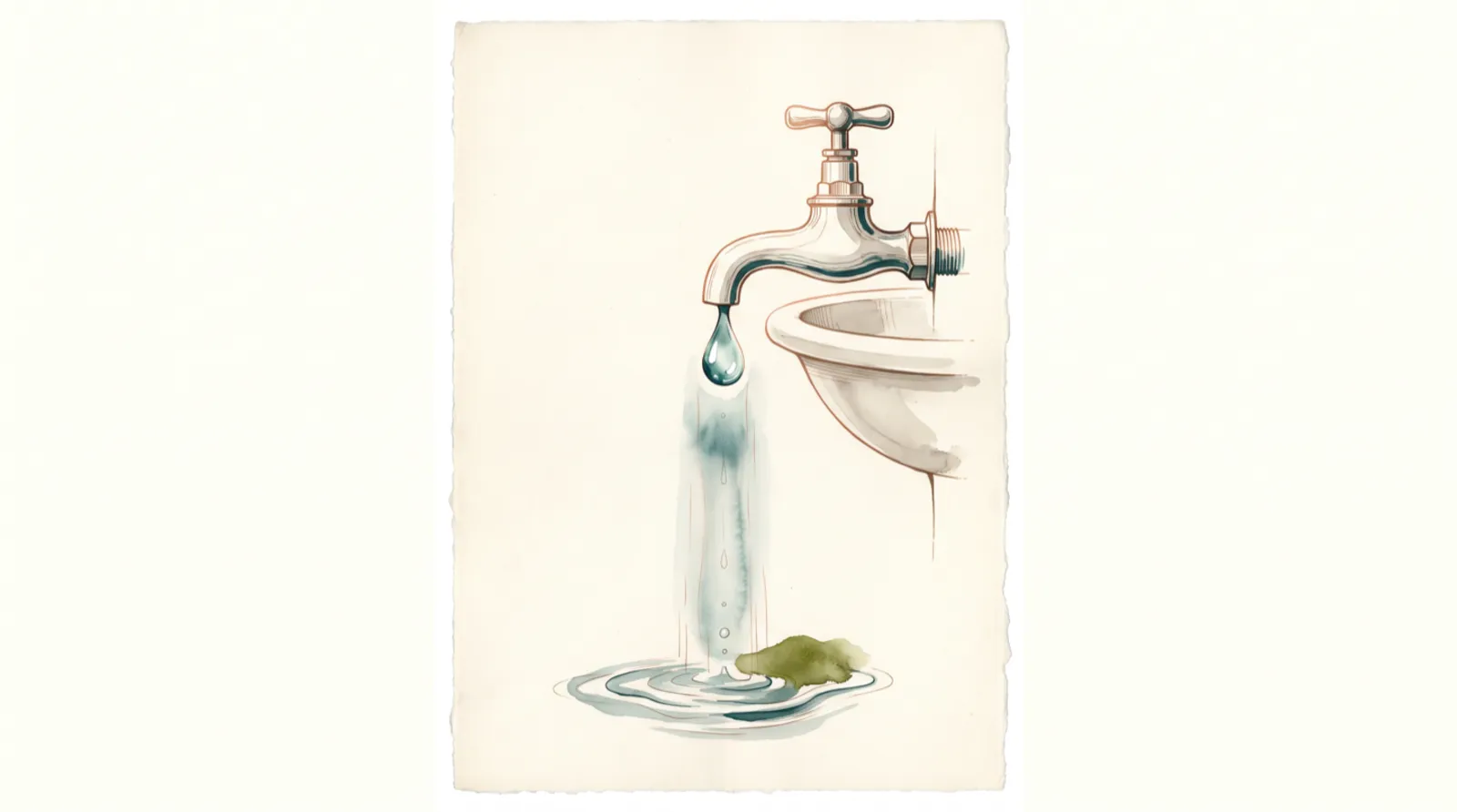
Behind the wall, the supply line sits under mains pressure the entire time, whether the tap is open or shut. Inside a common household tap, a small movable seal is pressed hard against a fixed metal seat to close the waterway. Turn the handle and the seal lifts, the water rises through the seat and out the spout. Turn it back and the seal returns to the seat. The seal is the part that does the work, and the part that wears; the seat is the surface it works against, and the surface that spoils it.
Two facts on this drawing decide almost everything else in the guide. The pressure never switches off, so a seal that is even slightly imperfect leaks continuously, not occasionally. And the seat matters as much as the washer: a fresh washer on a spoiled seat is a new tyre on a bent rim.
The facts panel
- Governing standard
- AS/NZS 3500.1
- Max pressure at a fixture
- 500 kPa
- Replacing a washer
- minor maintenance *
- Replacing tapware or pipework
- licensed work
- A steady drip wastes
- 12,000+ L/yr
AS/NZS 3500.1 (Water services) applies across Australia through the Plumbing Code of Australia. *What a householder may do without a licence differs by state and territory. Litres figure: YourHome. See sources.
02 The taps in your house
Almost every tap in an Australian home seals in one of two ways, and knowing which you have changes what a repair even means.
Compression taps are the traditional design: the ones with separate hot and cold handles that you keep turning, that get firmer as they close. Inside is the washer-on-seat arrangement in Fig. 2. They are cheap, repairable with a washer, and the classic dripper, because a rubber washer is a consumable and the seat behind it slowly spoils.
Ceramic disc taps are almost everything modern: quarter-turn taps and single-lever mixers. Instead of a washer, two polished ceramic discs sit face to face; a small turn slides the holes in them into or out of line. There is no rubber to flatten, so they last far longer and rarely drip. When they do fail, you replace a cartridge (the sealed unit the discs live in), not a washer, and the part is tap-specific rather than a generic size.
If you are tired of re-washering the same tap every couple of years, the honest fix is often not another washer but a ceramic disc replacement: either a drop-in ceramic-disc valve to suit the tap, or a new tap. It is the difference between maintaining a wearing part and removing the wear.
03 Why taps drip (and why the drip comes back)
A dripping compression tap is almost always one of three things, and they stack: fix the obvious one and miss the quiet one, and the drip returns.
A worn washer. The rubber flattens, hardens and splits with age and use, and stops filling the seat cleanly. This is the first suspect and the easy fix, and for many taps it is the whole story.
A scored or corroded seat. This is the one that catches people out. The seat is brass, and years of a hard washer grinding onto it, plus mineral scale and corrosion, leave its face pitted and rough. A brand-new washer cannot seal against a rough seat, so the tap drips again within weeks and the obvious conclusion, wrongly, is that the new washer was faulty. The real fix is to re-cut the seat smooth with a reseating tool (or, on some taps, drop in a seat insert) before fitting the new washer.
Too much pressure. High static pressure drives the washer into the seat harder every time the tap closes, so both wear faster, and it is a common reason a house seems to eat washers. Australia's plumbing standard caps pressure at a fixture at 500 kPa; where the street pressure runs higher, a pressure limiting valve at the meter brings the whole house back into range and quietly extends the life of every tap, mixer and appliance hose behind it.
That is the seat talking, not the washer. Another new washer will drip too. The seat needs re-cutting or the tap needs a ceramic-disc valve. This single point is the most useful thing on this page: a drip that survives a fresh washer is a seat problem, every time.
Two more, less common but worth naming: a perished O-ring, which shows as water weeping from around the base or handle rather than the spout, and a loose or split fitting upstream, which is a leak from the pipework rather than the tap and belongs to a licensed plumber.
04 Reading the signs
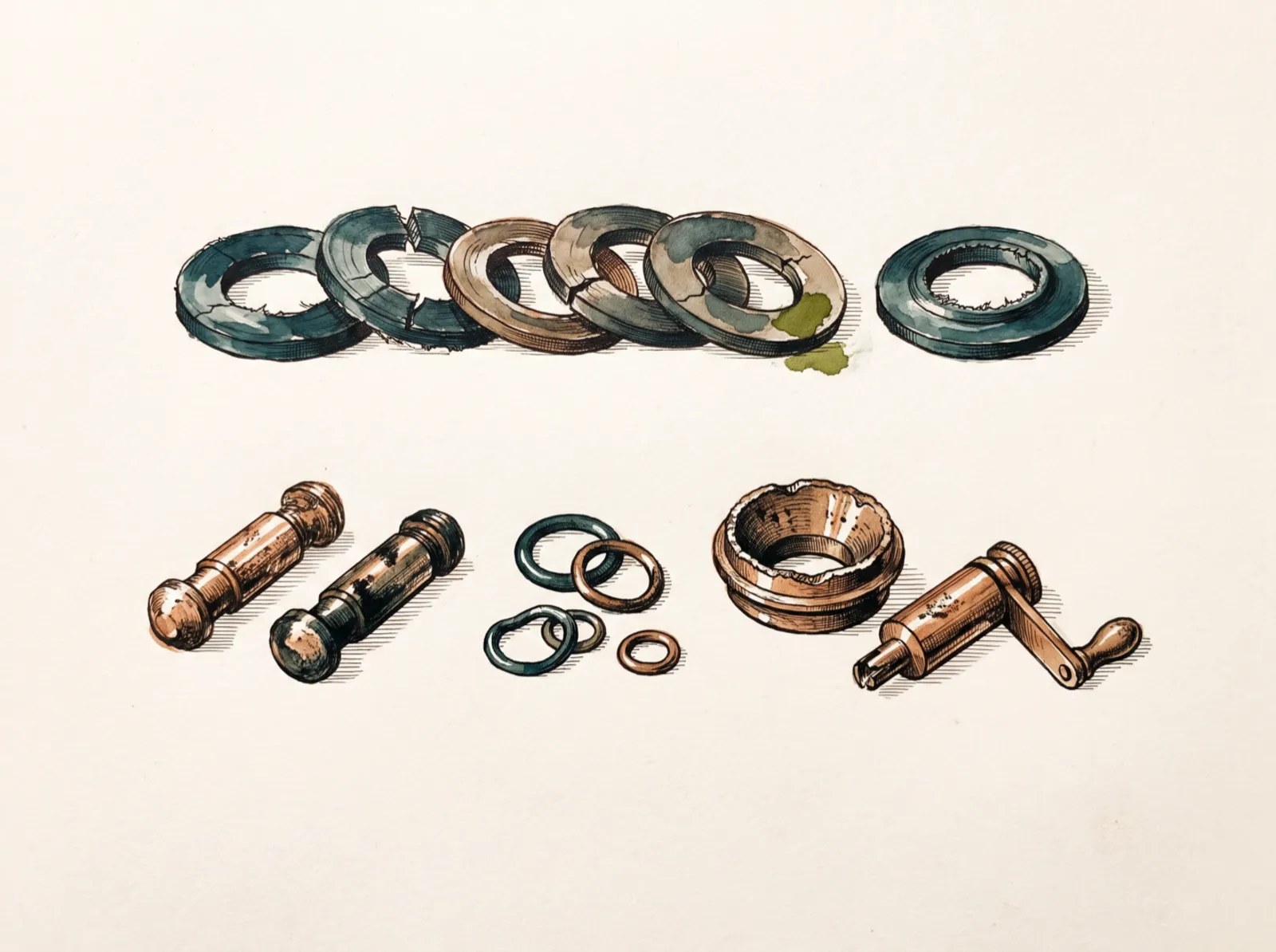
Where a tap leaks from tells you what is worn, before you touch a tool.
Dripping from the spout when the tap is firmly off is the classic washer-or-seat story from section 03: the seal is not closing the waterway. This is the most common leak and the most fixable.
Water weeping from the base or handle while the tap runs points at the O-ring or gland around the spindle, not the washer. The spout can be bone dry and the tap still be leaking, down the outside of the body.
A tap you have to crank hard, or that squeaks, is warning you it is spoiling the seat with every close. Forcing a compression tap shut to stop a drip accelerates exactly the wear that caused it.
Green or blue-green staining in the basin under a tap is dissolved copper and mineral left by water that has been running or sitting too long, and a slow tell that a fixture has been weeping for a while. The water quality side of a neglected leak is its own subject, covered in water quality concerns related to leaking taps.
A mixer that dribbles after you push the lever down, or runs warm when set to cold, is usually a failing cartridge rather than anything you can re-washer. It is still a small part, but a tap-specific one.
05 What is safe to do yourself
Before anything else, the legal line, because it is not the same everywhere. In most Australian states and territories, replacing a tap washer is treated as minor maintenance a householder may do. Almost everything past it, replacing the tapware, altering the pipework, and anything on the hot-water or gas side, is licensed plumbing work. The exact boundary differs by jurisdiction, so check your state or territory plumbing regulator before you go further than a washer. What follows assumes a standard compression tap and stops at that line.
Isolate the water first, every time. Close the isolating valve under the fixture if there is one, or the main stop tap at the meter, then open the tap to drain the pressure and confirm the water is truly off. Plug the basin so nothing small disappears down the drain.
Replacing the washer, honestly rated. Genuinely a homeowner job on a compression tap: lever off the handle button, undo the bonnet, lift out the headwork, and swap the washer at its base for one of the same size. Ten minutes and a few dollars. The one honest caveat is the seat underneath it (next item), which is why so many washer jobs seem to fail.
Re-cutting the seat, rated with care. A reseating tool grinds the brass seat smooth again so a new washer can seal. It is inexpensive and it is the step that actually stops a recurring drip, but it removes metal and it is easy to overcut or cut crooked, which spoils the seat for good. If you are not confident, this is a fair point to hand the whole job to a plumber, who does it in minutes with the right tool.
Cleaning the aerator. Weak or spitting flow is often just the little mesh screen on the spout tip furred with scale. Unscrew it, soak it in vinegar, rinse and refit. It is not a leak fix, but it is the one genuinely harmless tap job on any tap type, and it restores flow people often mistake for a bigger fault.
Washer, seat and aerator on a standard compression tap are honest homeowner work where your state allows it. The rule that keeps it that way: if the tap is a mixer, if the leak is at the base rather than the spout, if the pipework behind the tap is involved, or if it is the hot side, stop. Those are the next section.
06 When it is a licensed plumber's job
Plumbing in Australia is licensed work for good reasons, and a few tap leaks land squarely on the licensed side of the line no matter how handy you are.
- Replacing the tap itself. Swapping tapware means undoing supply connections under pressure and remaking watertight joints. In most jurisdictions that is licensed work, not maintenance.
- Anything at the pipework. A leak from the connection behind the tap, a weeping isolating valve, or a wall that stays damp is a supply-side fault. Concealed and under constant pressure, it does not wait.
- Mixer and cartridge faults on better tapware, where the part is brand-specific and the body is easily damaged getting the cartridge out.
- The hot side. Any leak involving the hot water system, a tempering valve or a gas appliance is licensed work, and on gas, specialised licensed work.
- Whole-house pressure. Fitting or adjusting a pressure limiting valve at the meter to bring the house under 500 kPa.
What good looks like, and what you are paying for, is a plumber who fixes the cause rather than the symptom: they check the seat, not just the washer; they check static pressure if the house keeps eating washers; and on a tap worth keeping they will often convert it to a ceramic-disc valve so it stops dripping for years rather than months. Two questions sort the method from the guess: do you re-cut or replace the seat, and do you check the pressure. If a tap is one of several niggles, or you are simply not sure which side of the line you are on, describe the leak to us and we will tell you plainly whether it is a washer afternoon or a plumber's call.
07 Repair or replace
Not every dripping tap is worth saving, and not every one is worth binning. The honest decision turns on a few things:
- Age and history. A tap you have already re-washered two or three times, or one past fifteen or twenty years, is telling you the seat and body are tired. At that point a replacement stops the cycle for less total effort than the next repair and the one after it.
- What it is. A quality compression tap on a spoiled seat is worth reseating. A cheap tap, or one where the seat is corroded past re-cutting, is worth replacing, ideally with a quarter-turn ceramic disc tap that removes the wearing washer entirely.
- Water efficiency. Replacing is also the moment to gain efficiency you cannot retrofit. Taps sold in Australia carry a WELS star rating (waterrating.gov.au): more stars means less water for the same useful flow, through flow regulation built into the tap. On a tap you use every day, the higher-rated fixture keeps saving water long after the leak is a memory.
- The rest of the room. If a renovation is coming, a leaking tap is a repair to get you through, not a replacement to do twice.
The through-line: repair the tap that is fundamentally sound and cheap to keep sealing; replace the tap that fights you, and take the efficiency dividend when you do.
08 What a drip really costs
A drip looks trivial because each drop is trivial. The cost is in the arithmetic of a flow that never stops.
A steadily dripping tap wastes more than 12,000 litres a year (YourHome, Australian Government). That is drinking-quality treated water leaving the house continuously, and if it is the hot tap, you are also paying to heat every litre of it before it drips away. A leak you can barely see runs up a bill and a carbon cost you certainly can.
Toilets deserve their own line, because a cistern leak is the biggest hidden waster in most homes and the hardest to notice: it leaks silently into the bowl, not onto the floor. YourHome puts a leaking toilet anywhere from about 4,400 litres a year for a barely visible leak to 96,400 litres for a constant one. The dye test finds it: a few drops of food colouring in the cistern showing up in the bowl within fifteen minutes, without flushing, means it is leaking.
Beyond the meter, a neglected leak has a wider bill. The environmental side, the treated water and the energy behind it, is set out in the environmental consequences of neglected leaking taps; the effect on the water you actually drink and cook with is covered in water quality concerns related to leaking taps. The short version is that the cheapest litre of water is the one a working seal never lets go.
09 Prevention that works
Taps last longest when they are asked to do less, and none of this is expensive.
- Do not over-tighten. The single biggest killer of washers and seats is closing a tap harder than it needs. Turn it until the water stops, then stop. A tap that only seals when cranked is already worn, and cranking it finishes the seat.
- Bring the pressure into range. If your house hammers when a tap or appliance shuts, or your washers keep failing, have the static pressure checked and a pressure limiting valve fitted if it is over 500 kPa. It protects every seal in the house at once.
- Choose ceramic when you replace. A quarter-turn ceramic disc tap or mixer has no washer to wear, so the next twenty years of drips simply do not happen.
- Look, once a season. A ten-second glance and a hand on the spout catches a starting drip while it is a washer, not after it has stained a basin or run for a year. The habit, and a few others, are in preventive maintenance for prolonging tap lifespan.
- Clean aerators before they clog. A yearly vinegar soak of the spout screens keeps flow honest and stops the spitting people mistake for a fault.
10 Questions, answered
Can I legally replace a tap washer myself?
In most Australian states and territories, yes: replacing a washer on a standard tap is treated as minor maintenance a householder may do. But the line between maintenance and licensed plumbing work is set by each state and territory, and it sits in a slightly different place in each, so check your state or territory plumbing regulator before you go past the washer. Replacing the whole tap, touching the pipework, or anything on the hot or gas side is licensed work everywhere.
I replaced the washer and the tap still drips. Why?
The seat, almost certainly. The washer closes onto a brass seat, and years of wear, scale and corrosion leave that seat rough. A new washer cannot seal against a rough face, so the tap drips again within weeks. The fix is to re-cut the seat smooth with a reseating tool before fitting the washer, or to convert the tap to a ceramic-disc valve. A drip that survives a fresh washer is a seat problem, not a bad washer.
Should I choose a washer tap or a ceramic disc tap?
For anything new, ceramic disc. Compression (washer) taps are cheap and repairable, but the washer is a consumable and the seat behind it slowly spoils, so they are the taps that drip. Ceramic disc taps and mixers seal dry ceramic on ceramic with nothing rubber to flatten, which is why they run for years without a drip. The trade-off is that when a ceramic tap does fail you replace a tap-specific cartridge rather than a generic washer.
Does high water pressure really wear taps out faster?
Yes. Higher pressure drives the washer into the seat harder every time the tap closes, so both wear faster, and it is a common reason a house seems to eat washers. Australia's plumbing standard caps pressure at a fixture at 500 kPa; if your street pressure runs higher, a pressure limiting valve at the meter brings the whole house into range and extends the life of every tap and appliance hose behind it. Water hammer when a tap shuts is the audible warning sign.
How much water does a dripping tap actually waste?
More than 12,000 litres a year for a steady drip, on YourHome's figures, and it is drinking-quality treated water. If it is the hot tap you are also paying to heat every litre before it drips away. A leaking toilet, which leaks silently into the bowl, is worse again: YourHome ranges it from about 4,400 litres a year for a barely visible leak to 96,400 litres for a constant one.
Water is leaking from the base of the tap, not the spout. Is that different?
Different part, yes. A drip from the spout is the washer or seat closing the waterway. Water weeping from the base or handle while the tap runs is usually a perished O-ring or gland around the spindle. The spout can be completely dry while the tap still leaks down the outside of the body. It is still a small part, but on a mixer or better tapware, getting to it without damaging the body is often a job worth handing over.
+ The studies behind this guide
Three journal entries carry this guide's deeper dives, each kept at its original address and date:
11 Check your symptom
Two symptoms bring most readers to this guide, and the desk below handles both. Pick yours for the mechanism, the severity as we honestly read it, and what the drip is costing while you decide.
The interactive desk needs JavaScript, but the enquiry desk does not: describe what your tap is doing and we will point you in the right direction.
Sources
- YourHome: Reducing water use, the Australian Government's guide to environmentally sustainable homes. The litres figures on this page, a steady drip wasting more than 12,000 litres a year and a leaking toilet ranging from about 4,400 to 96,400 litres a year, come from here, as does the cistern dye test.
- Plumbing Code of Australia, Australian Building Codes Board. The national framework through which AS/NZS 3500.1 (Water services) applies, including the 500 kPa maximum pressure at a fixture referenced above. The standard itself is paywalled; the ABCB page describes its role. Plumbing is licensed at the state and territory level, and what a householder may do without a licence is set by each jurisdiction.
- Water Efficiency Labelling and Standards (WELS) scheme, the Australian Government's mandatory star rating for taps, mixers, toilets and other water-using products, referenced in the repair-or-replace section.
Tell us what your plumbing is doing
Describe the symptom, the fixture and how long it has been going on. We read every enquiry and reply with guidance and a sensible next step. Anything that needs tools is a licensed plumber's job, and we will say so plainly.