Broken and burst pipes: why they fail, and what to do the moment one does
A pipe almost never breaks out of nowhere. It corrodes from the inside, it absorbs years of pressure spikes, it shifts with the ground or freezes on the one cold night a year, and then a joint lets go. This guide covers why pipes fail, the five minutes that decide how much a burst costs you, how to find a leak you cannot see, and how the repair actually happens.
Updated 16 July 2026 · Reading time approx. 16 min
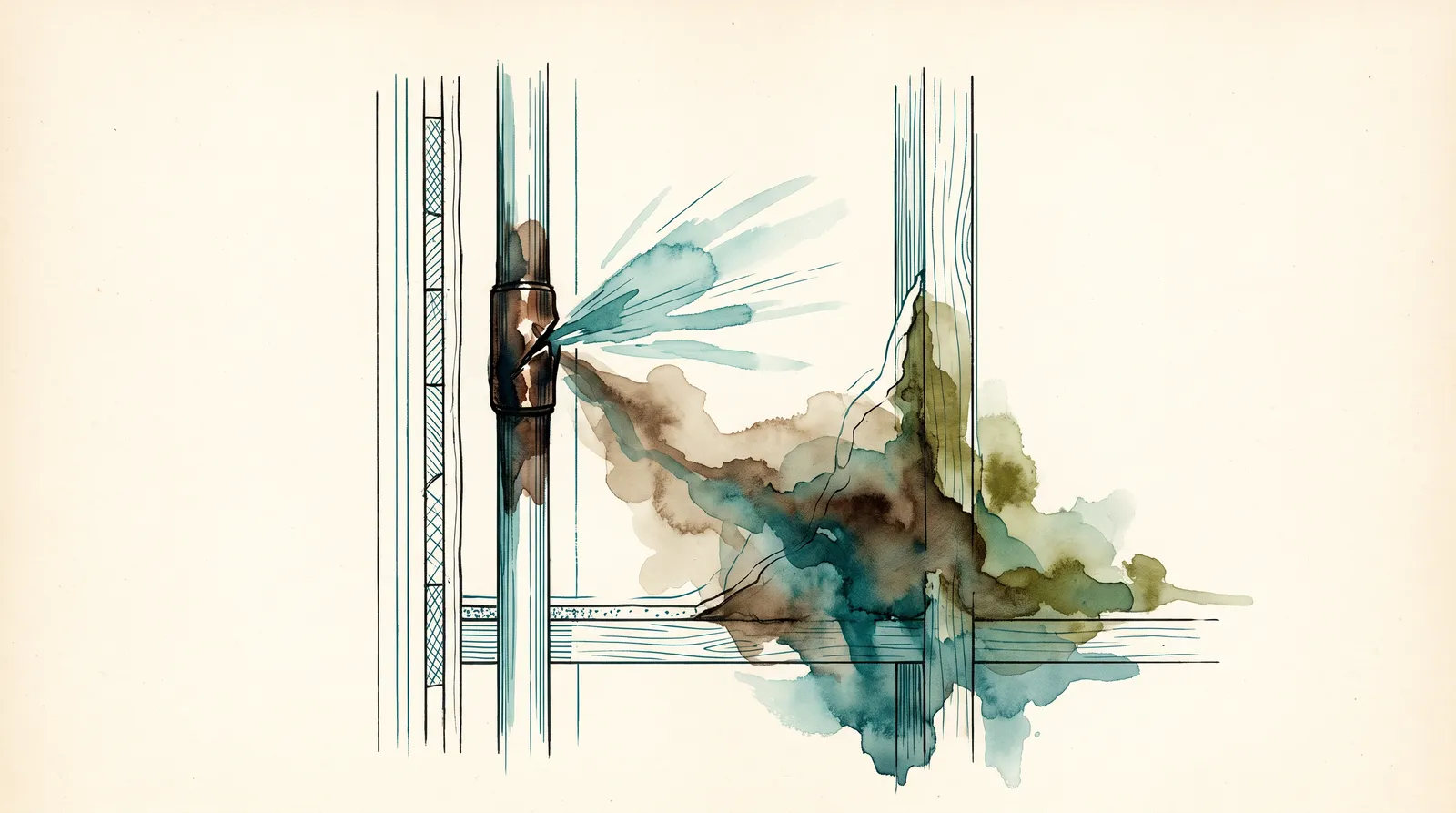
01 Supply and drainage: two systems, two kinds of trouble
Your home runs two entirely separate pipe networks, and telling them apart is the first move in almost every pipe problem.
The supply system is the pressurised half. Water arrives from the street main, through your water meter at the boundary, and every pipe past that point is under mains pressure day and night, whether a tap is open or not. That is why a supply leak sprays, never stops, and shows up on the meter even at three in the morning.
The drainage system is the other half, and it carries no pressure at all. Wastewater leaves each fixture and falls to the sewer by gravity, which means a drainage pipe only holds water while a fixture is actually running. A leak there shows up intermittently, after a shower or a wash, and never on a still meter.
Find your main stop tap now, before you ever need it in a hurry, and make sure it turns. An old stop tap that has not been moved in years can seize; a plumber can free or replace it in a routine visit, which is a far better time to discover the problem than during a burst.
The facts panel
- Max static pressure at most outlets
- 500 kPa (AS/NZS 3500.1)
- Main stop tap
- at the meter, clockwise to close
- Water supply work is
- licensed work
- Water tracks along
- framing & slab, not straight down
- Storm or flood emergency
- SES, 132 500
AS/NZS 3500.1 (Water services) is applied across Australia through the Plumbing Code of Australia; the standard itself is paywalled. See sources below.
02 Why pipes fail
A broken pipe is almost always one of a short list of mechanisms. Knowing which one you are dealing with tells you whether it is a one-off or a warning about the whole run.
Age and wear. Every pipe material has a working life, and the joints and fittings age fastest of all. A house full of original galvanised steel or early plastic is not failing because of one bad day; it is failing because the material has reached the end of its service life, and the next weak joint is only ever a matter of time.
Corrosion. Metal pipe thins from the inside out. It can go uniformly (the whole wall wears down), or as pitting (a tiny pinhole eats through in one spot, the classic copper failure), or galvanically where two different metals meet in water and behave like a small battery, sacrificing the weaker one. Section 05 covers what corrodes and what does not.
Water pressure that is too high. Utilities often set mains pressure high to reach every home on the network, and that baseline can sit above what household plumbing is meant to carry. High pressure stresses every joint continuously, accelerates corrosion, and shortens the life of taps, hoses and appliance valves. A pressure limiting valve at the meter brings it back into range, and if your taps thump or your flexi hoses keep failing, pressure is the first thing to have measured.
Water hammer. Moving water has real mass. When a quick-closing valve (a washing machine, a dishwasher, a quarter-turn tap) stops it dead, the pressure wave has nowhere to go and slams through the pipework. You hear it as a bang; the pipes feel it as a shock that works on joints and hoses every single cycle. It is on the symptom desk below because it is so often the thing people learn to live with, right up until a joint gives out.
Ground movement. Much of Australia is built on reactive clay soils that swell when wet and shrink when dry. That movement flexes a slab and shears rigid buried pipe at its joints, which is why a drainage line can crack years after it was laid perfectly. A leak that keeps returning at the same buried joint is usually the ground, not the pipe.
Temperature. Pipes expand when hot water runs through them and contract as they cool, and years of that cycling work joints loose (thermal fatigue). In frost country a single freeze can split a pipe outright. Both are section 06.
A pipe that fails once, in an accessible spot, from an obvious cause is bad luck. A pipe that fails repeatedly in the same place, or a run where one joint after another starts to weep, is telling you the material or the pressure is the problem, and no amount of patching individual failures will fix that.
03 A burst pipe: the first five minutes
A burst is a supply pipe, under pressure, letting go, and the volume of water it moves is the whole problem. The damage in the first five minutes is almost entirely in your hands, and the order matters.
- Shut the water off at the main stop tap. This is the one from Fig. 2: at the meter, clockwise to close. If you have an internal isolation valve and it is closer, use whichever you reach first. Everything else is easier once the water has stopped arriving.
- Kill the power to anything wet. If water is anywhere near light fittings, power points or an appliance, switch off that circuit (or the mains) at the switchboard before you touch anything. Water and electricity is the part of a burst that hurts people, not property.
- Open the lowest cold taps. With the main off, run the lowest taps in the house to drain the pipes down. It relieves the trapped pressure and empties the line, so there is less water left to escape from the break.
- Contain and lift. Move what matters above the water, lift rugs, and get buckets and towels under the leak. Ceilings holding water are dangerous; if a ceiling is bulging, keep people out from under it.
- Photograph everything before you clean up. The water, the source, the damage to floors, walls and belongings. Insurers pay on evidence, and the evidence disappears the moment you start mopping.
- Call a licensed plumber. The water is off and the house is safe; now it is a repair, not an emergency. If you rent, tell your landlord or agent at the same time, in writing, and let them arrange the plumber unless it cannot wait.
A pipe clamp or a wrap can stop a spray long enough to save a floor while you wait, and that is worth doing. The permanent repair is licensed work every time: a joint that looks fine and is not, behind a wall, under constant pressure, is exactly the failure you do not want to redo. Stopping the water and calling a plumber is the whole DIY story for a burst.
05 What pipes are made of, and how they corrode
What your pipes are made of decides how they age, whether a failure is a patch or a re-pipe, and how green the replacement can be. These are the materials you will meet in an Australian home, roughly oldest to newest.
| Material | Typically used for | Indicative life | How it fails |
|---|---|---|---|
| Galvanised steel | Supply, older homes | 40–60 yr | Zinc wears, then rusts from inside; bore narrows, water browns |
| Copper | Supply, hot & cold | 50–70 yr | Pinhole pitting; solder joints are the weak point |
| uPVC / PVC | Drainage, cold supply | 50+ yr | Brittle to impact and UV; solvent joints can fail |
| PEX | Modern supply | 50+ yr | Few joints to fail; sensitive to UV and rodents |
| HDPE / poly | Mains, trenchless | 50+ yr | Heat-fused joints rarely leak; flexes with ground |
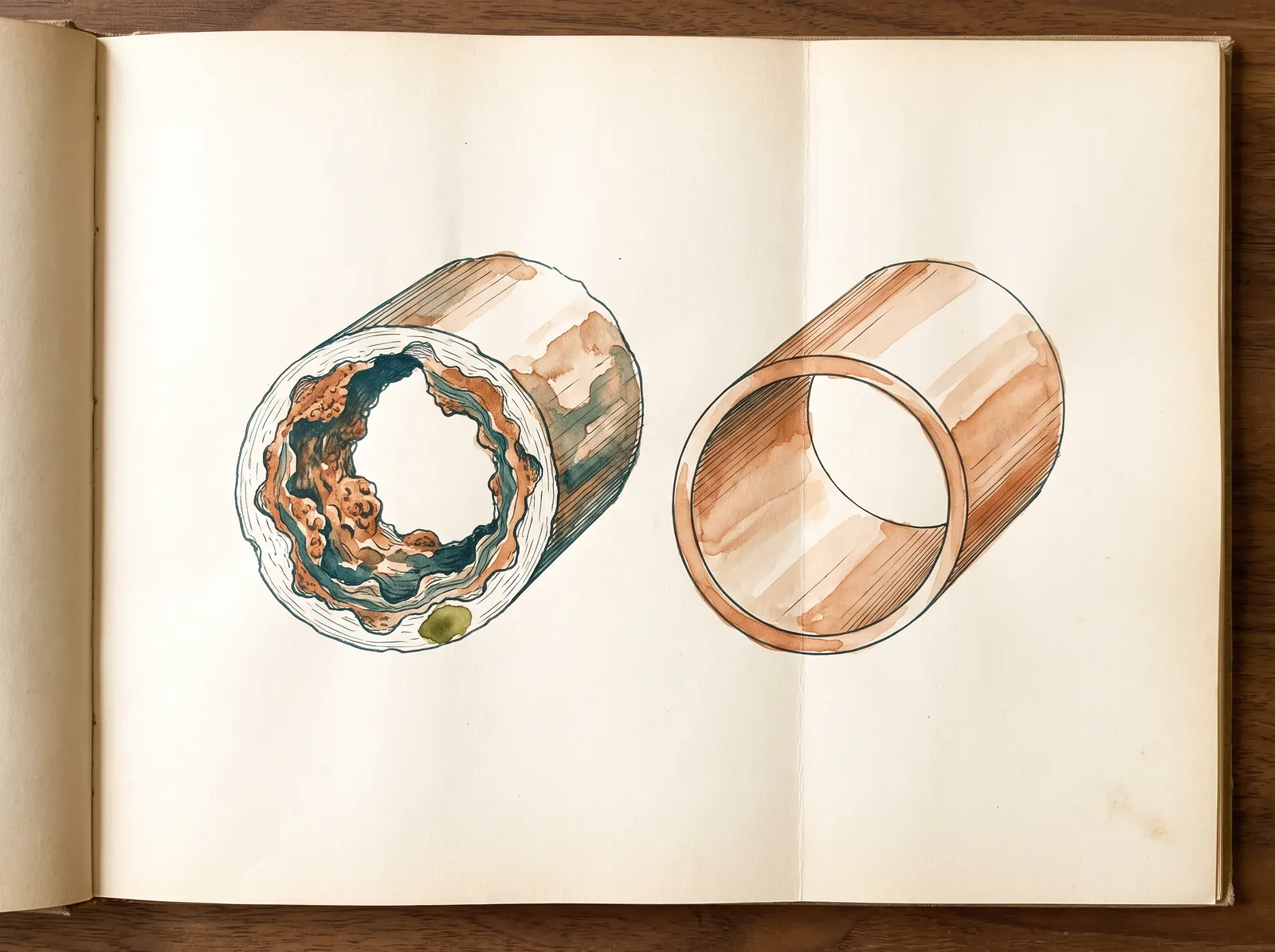
Corrosion is not one thing. Uniform corrosion thins a whole pipe evenly. Pitting concentrates the attack into a spot and drills a pinhole, which is how sound-looking copper springs a leak. Galvanic corrosion happens wherever two dissimilar metals are joined in water (an old galvanised line plumbed into newer copper is the classic culprit): the pair acts like a battery and the less noble metal corrodes fast. High water velocity and pressure add erosion-corrosion, scouring away the protective film a pipe would otherwise grow. This is why the honest answer to a failing galvanised run is usually to replace it, not to chase pinholes one at a time.
The eco angle sits here too. Copper, stainless steel, cast iron and HDPE are all recyclable, and choosing a durable, recyclable material that will not need replacing in a decade is the greenest plumbing decision most homes ever make. PVC is cheap and long lasting but is neither biodegradable nor easy to recycle, which is why modern sustainable builds increasingly reach for PEX, HDPE and recycled copper instead.
06 Frost and heat: the temperature failures
Frozen pipes are a real cause of bursts, but honesty matters here: for most of coastal Australia they are not a concern at all. Where they bite is the cold country, the alpine areas, tablelands and highlands where hard frosts are normal: the Snowy Mountains, the ACT, the Central and Southern Tablelands, New England, the Victorian high country and Tasmania's highlands. If that is not where you live, you can read this section as background and move on.
Where it does freeze, the mechanism is simple and unforgiving. Water expands by roughly nine per cent as it turns to ice, and an ice plug in a pipe builds enormous pressure in the closed length of water between the plug and a shut tap until the pipe splits. Cruelly, the split often shows only when it thaws and the water starts moving again. Prevention in frost country is ordinary care: lag exposed pipes with foam insulation, disconnect and drain garden hoses and outdoor taps before a hard frost, let a tap trickle on the coldest nights so water keeps moving, and keep a little heat on if you are away. And know where your stop tap is, because a thaw is exactly when you will need it.
Heat is the quieter cousin. Pipes expand and contract every time hot water runs through them, and over years that repeated cycling works fittings loose and fatigues the material, a process called thermal fatigue. Long straight hot-water runs and pipes that see big day-to-night temperature swings take the worst of it. We cover the mechanism, the experimental evidence and how to design it out in a dedicated study, linked at the foot of this guide.
07 How a broken pipe gets repaired
There is a ladder of repair methods, from the small and local to the whole-run, and a good plumber picks the lowest rung that genuinely fixes the fault.
Spot repair or section replacement. For a single accessible failure, the plumber cuts out the failed length and joins in new pipe, using whatever joint suits the material: a compression or push-fit fitting, a soldered copper joint, a solvent-welded PVC joint. Right for one bad joint; wrong as a habit if the whole run is on the way out.
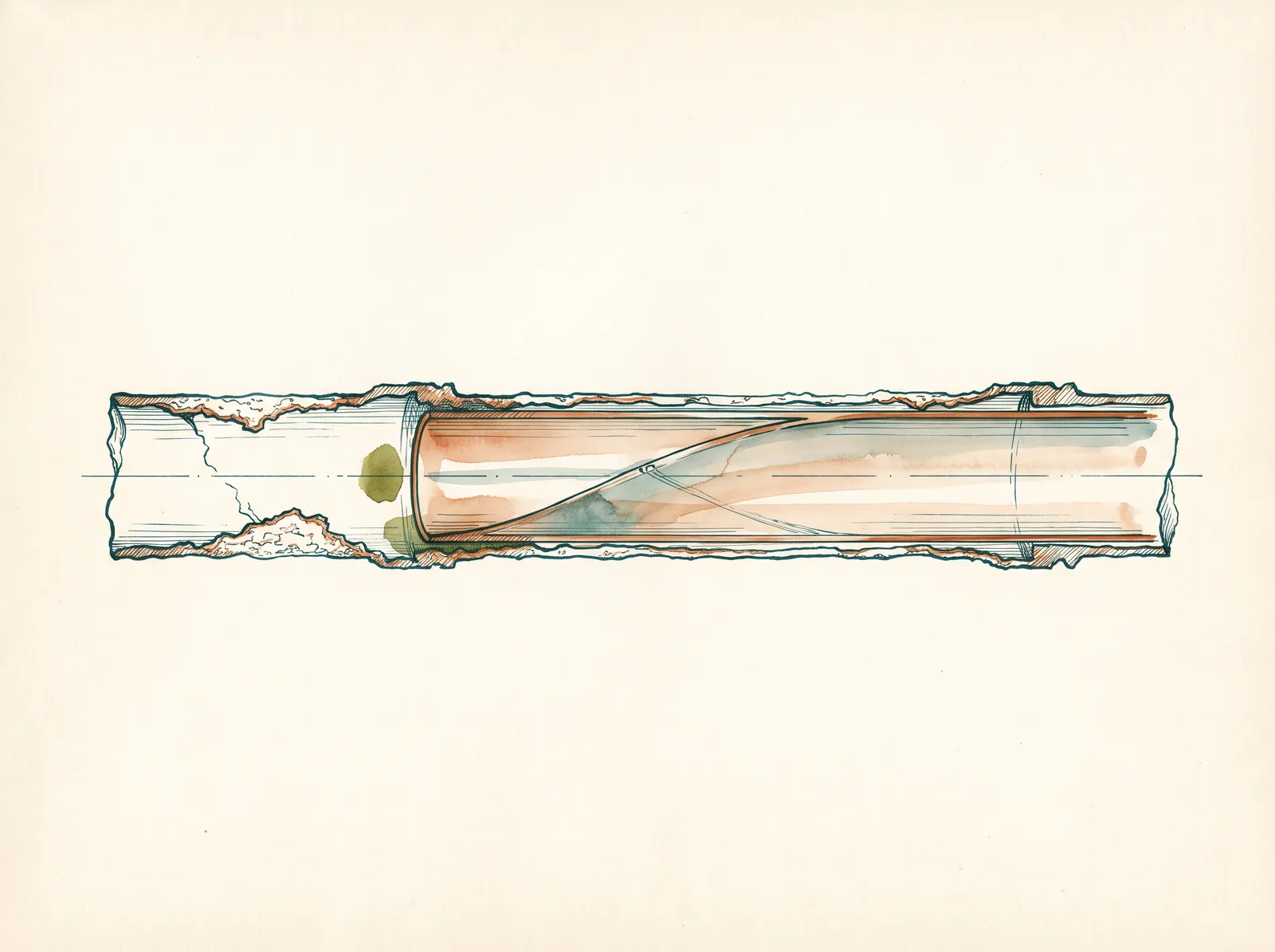
Pipe relining. For a buried drainage pipe that is cracked or root-damaged but still holding its shape, relining fixes it with no trench at all. A resin-saturated liner is drawn or inverted into the old pipe and cured in place (the method is called cured-in-place pipe, or CIPP), forming a smooth, jointless new pipe inside the old one. The lawn, the driveway and the paving stay where they are, which is both cheaper and far less destructive than digging.
Pipe bursting. When a pipe is too far gone to reline (collapsed, or it has lost its line), a bursting head is pulled through it, fracturing the old pipe outward while it draws a new HDPE pipe into the same path behind it. Still trenchless, apart from a small access pit at each end.
Full replacement or re-pipe. When an entire run has reached the end of its life (the tell-tale being one failure after another in old galvanised steel), patching individual leaks is spending good money on a lost cause. Re-piping the run in copper or PEX is the honest answer, and it is the moment to design the pressure and the layout properly so the next fifty years are quiet.
What good looks like, whichever rung it lands on, is the same in every case: the leak located before any wall or lawn is opened, a camera down a drain before anyone digs, and a repair that ends with a reason the pipe failed, not just a patch over the symptom. A finding is what stops it happening again.
08 When it is a licensed plumber's job
Water and drainage work in Australia is licensed work, and with pipes that is not red tape. Supply plumbing is under constant pressure, hot-water and gas systems sit right beside it, and the cost of a joint that looks fine and is not, hidden behind a wall, lands months later as rot and mould. Turning the water off and stopping a spray is yours; the repair, from the smallest soldered joint to a full re-pipe, is a licensed plumber's.
A burst that will not wait for business hours is the one case where speed genuinely matters, because every minute the water runs is more damage. For readers in Newcastle and the Hunter, the name we give when asked is Green Planet Plumbing's round-the-clock emergency team, who work the shut-off-and-make-safe sequence above and carry the leak-detection gear to find the concealed ones. Anywhere else, one question sorts an emergency plumber quickly: do you locate a leak before you open a wall? A plumber who answers "always" charges you for one hole instead of five.
One line belongs here for renters, because it is the most common broken-pipe question we are sent. In a rental, a burst or a leak is the landlord's to repair, and usually urgent repairs under your tenancy laws; your job is to make it safe, tell the agent or owner in writing straight away, and keep the photos. You are not expected to pay for a plumber to fix the building's pipes.
09 Questions, answered
My water bill jumped but I cannot see a leak. What now?
Run the meter test in section 04. Turn off every tap and water-using appliance, read the meter (numbers and the little leak dial), wait fifteen to thirty minutes using no water at all, then read it again. Any movement means water is escaping on your side of the meter, and the next step is a plumber with leak-detection gear, not a builder opening walls at random.
Where is my main water shut-off, and which way does it turn?
The main stop tap is at your water meter, usually near the front boundary, and it turns clockwise to close. Many homes also have an internal isolation valve on the incoming line; in an emergency use whichever you reach first. Find it and test it on a calm day: a seized stop tap discovered during a burst is the worst possible time.
Is a burst pipe my problem or the water utility's?
The boundary is the point of connection: everything on your side of it is yours to repair, and the water main on the street side belongs to the utility. A break at the main tends to announce itself as water rising in the street or several houses losing pressure together; ring your water utility first in that case, because main faults are fixed at the utility's cost, not yours.
Can I fix a burst or leaking pipe myself?
You can and should make it safe: shut the main off, kill the power to anything wet, and a proprietary pipe clamp or repair wrap can hold back a spray while you wait. The permanent repair is licensed work in Australia. A supply joint under constant pressure, often behind a wall, is exactly the repair you do not want to do twice, and a botched one voids the insurance claim on the damage it later causes.
Do pipes really freeze in Australia?
In most of the country, no, and it is worth saying plainly rather than selling you insulation you do not need. Frozen pipes are a genuine risk only in the cold-country areas: the alpine regions, the tablelands and highlands, the ACT and Tasmania's high ground. If that is you, section 06 has the prevention; if it is not, this is one failure mechanism you can cross off.
What is pipe relining, and when is it used instead of replacement?
Relining draws a resin-saturated liner into an old buried pipe and cures it hard in place, forming a smooth new pipe inside the old one with no trench dug. It suits a pipe that is cracked, leaking or root-damaged but still holding its shape and line. A pipe that has collapsed or lost its fall is past relining and becomes a case for pipe bursting or open replacement. A camera inspection is what tells the two apart.
+ The study behind this guide
One journal entry carries this guide's deeper dive, kept at its original address and date:
10 Check your symptom
The desk below covers this guide's territory: the pipes you can hear, the leaks you cannot see, and the pressure behind both. Pick what you are noticing for the mechanism and an honest severity read, then send us the specifics.
The interactive desk needs JavaScript, but the enquiry desk does not: describe what your pipes are doing and we will point you in the right direction.
Sources
- Plumbing Code of Australia, Australian Building Codes Board. The national framework through which AS/NZS 3500.1 (Water services) applies, including the maximum static pressure figure quoted in section 01. The standard itself is paywalled; the ABCB page describes its role and scope.
- YourHome: Reducing water use, the Australian Government's guide to environmentally sustainable homes. The source for the water-waste framing used in section 04 and across this site.
- NSW State Emergency Service. Source for the storm and flood guidance in section 03; the SES assistance line, 132 500, is answered in every state and territory.
Tell us what your plumbing is doing
Describe the symptom, the fixture and how long it has been going on. We read every enquiry and reply with guidance and a sensible next step. Anything that needs tools is a licensed plumber's job, and we will say so plainly.