Blocked drains: what's actually happening under your yard
A drain does not block in an afternoon. It narrows for months, tells you about it in gurgles and smells, and only then stops. This guide covers the mechanisms, the signs worth reading, what is genuinely safe to clear yourself, and the point where the job belongs to a licensed plumber and their cameras.
Updated 16 July 2026 · Reading time approx. 14 min
01 The system under the lawn
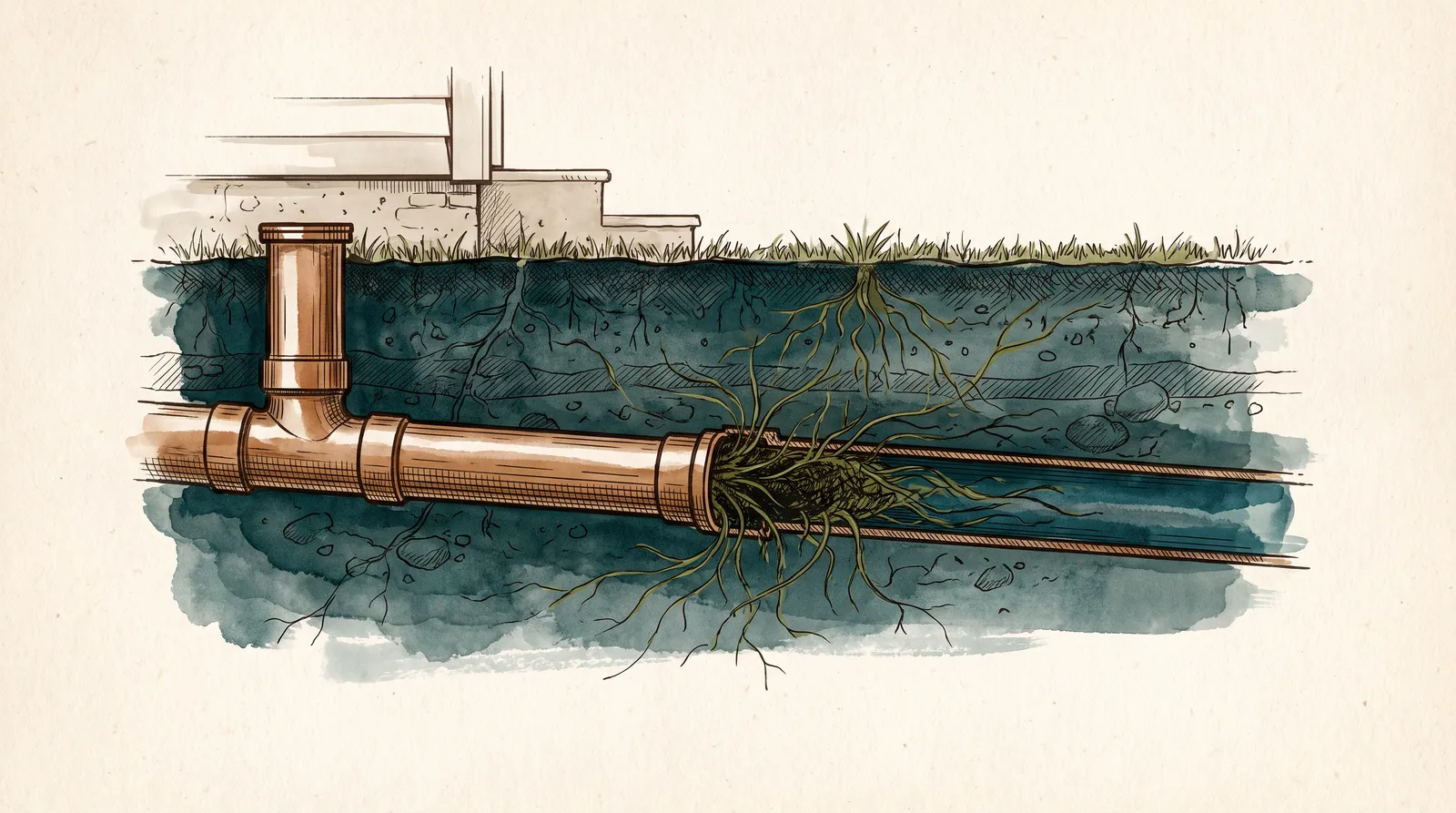
Every fixture in your house drains into the same buried line, and the whole arrangement runs on two quiet ideas: gravity and water seals.
Water leaves a sink or shower through a trap, the U-shaped bend under the plughole that always holds a small plug of standing water. That water is a seal: it lets waste through but keeps drain air out of the room. Each fixture's branch then falls into the house drain, a buried pipe (typically DN100, about 100 mm across) laid on a steady fall so that water and solids keep moving together to the street, where your line joins the sewer main. Near an external wall sits the overflow relief gully: a grated drain set deliberately lower than any fixture indoors, so that if the buried line ever blocks completely, sewage surfaces in the garden rather than in your shower.
Two consequences follow from this layout, and they do most of the diagnostic work in this guide. First: a problem at one fixture lives in that fixture's branch, which is small pipe and often reachable. Second: a problem at several fixtures at once lives in the shared house drain, which is buried, bigger, and almost always a licensed plumber's territory.
The facts panel
- Typical house drain bore
- DN100 (100 mm)
- Governing standard
- AS/NZS 3500.2
- Picked up nationally by
- Plumbing Code of Australia
- Drainage work is
- licensed work
- Flood or storm emergency
- SES, 132 500
AS/NZS 3500.2 (Sanitary plumbing and drainage) is applied across Australia through the Plumbing Code of Australia; see sources below.
02 How drains actually block
Almost every blockage is one of five mechanisms, and knowing which one you have decides everything that follows.
Fat, oil and grease. Warm fat pours like a liquid and sets like a candle. It cools against the pipe wall within metres of the kitchen sink, leaves a tacky film, and the film catches everything that follows. This is the slow, cumulative blockage: the sink that has drained a little worse every month.
Hair and soap. In bathroom branches, hair knots into a net and soap residue binds it into a felt-like plug. It builds at the trap and the first bends, which is inconvenient and lucky at once: those are the parts you can reach.
Things that should never have gone in. Wet wipes (whatever the packet says), cotton buds, sanitary products, food scraps, children's toys. Unlike toilet paper, none of these break down in water; they travel until they snag.
Tree roots. A buried drain is the best-watered thing in the yard, and roots read the moisture gradient with precision. They enter at joints and cracks as filaments, then thicken into a root mass that first catches solids and finally fills the bore. Our study on tree root intrusion covers the mechanism, the species most often implicated, and what to plant near drains instead.
The pipe itself failing. Older earthenware lines crack and settle; joints open as ground moves; a section can belly (sag) so water pools and solids drop out of the flow. A blockage that keeps returning in the same place, no matter how many times it is cleared, is usually this: not dirt in the pipe but a fault of the pipe.
A drain that blocks once, clears easily and stays clear was probably just catching what you sent it. A drain that blocks in the same spot repeatedly is telling you about the pipe, not your habits. Keep a mental count; a plumber will ask.
03 Reading the signs
Drains announce a blockage in a fixed vocabulary. In rough order of escalation:
Slow drainage is the earliest and most useful sign: the bore is narrowing but still open. At this stage everything in the DIY section below is still on the table.
Gurgling is air being pulled through a trap's water seal because a partial blockage (or a starved vent) has upset the pressure in the line. A single gurgling fixture points at its own branch. A gurgle in the bathroom when the kitchen drains, or when the washing machine empties, points at the shared line downstream of both.
Smells mean either a dry or siphoned trap seal (the smell is drain air itself) or waste decomposing against a partial blockage. A cup of water restores a dry floor-waste seal in seconds; a smell that survives that test is build-up.
Toilet water levels moving on their own, rising high after a flush or sitting oddly low, mean the air and water balance in the line is wrong. Treat it as a partial blockage announcing itself.
Water or sewage at the overflow relief gully outranks everything above. The system's designed failure point is doing its job, and the buried line is blocked now.
Sewage surfacing at the gully, more than one fixture backing up at once, or wastewater rising into a shower or bath when the toilet flushes: stop running water indoors and call a licensed drainage plumber the same day. Nothing in the DIY section touches a blocked house drain.
04 What is safe to do yourself
Everything in this section shares three properties: it works on the reachable end of a fixture's own branch, it cannot damage the pipe, and it costs almost nothing. Work down the list in order.
Clean the plughole and stopper. Unglamorous, first for a reason: in bathrooms, a surprising share of "blockages" is a felt of hair and soap sitting within the first hand-span of pipe. Pull the stopper, clear it, rinse. Ten minutes, no tools.
Hot water, poured in stages. For grease films in kitchen branches: a kettle poured in two or three stages, with a minute between, melts and moves soft fat build-up. Use hot tap water rather than a rolling boil if your fixture connects with plastic (PVC) pipe: modern pipe tolerates hot water, but repeated boiling water at the trap is unkind to it, and unnecessary.
A plunger, used properly. The tool that actually shifts soft blockages. Block the overflow hole with a wet cloth (no seal, no pressure), cover the plughole completely, and work in firm rhythmic strokes: it is the repeated push-pull that walks a plug loose, not one heroic shove.
Bicarb and vinegar, honestly rated. The classic fizz is real chemistry but mild: carbon dioxide and salt water, agitation rather than dissolution. It freshens a smelly drain and helps keep a cleared drain clear. It will not eat through an established plug, and any page telling you otherwise is selling the theatre, not the result.
Enzyme or bacterial cleaners. The eco-credible option that actually earns its label: cultures that digest fat and organic film over hours and days. Excellent as scheduled maintenance and gentle on septic systems, too slow for a drain that is blocked today.
A hand drain snake. For a branch you can reach through the plughole or by opening the trap: feed, turn, retrieve, and expect what comes back to be disgusting (that is success). Stop at resistance you cannot work past gently; forcing a cheap snake around a fitting is how it kinks or breaks off in the pipe.
All of the above applies to a single slow or gurgling fixture. The rule: if two rounds of the list change nothing, stop. More of the same force adds risk, not information, and the next tools (opening the line, machine clearing) are licensed work.
05 What to skip, and why
Caustic drain cleaners. The supermarket bottles are typically sodium hydroxide based. The mechanism is aggressive oxidation and heat: enough, sometimes, to soften a hair plug, and enough, always, to deserve respect it rarely gets in a laundry cupboard. The case against reaching for them by default:
- The reaction generates heat in the trap, exactly where plastic pipe and rubber seals live. Repeated doses age both.
- If the chemical does not clear the plug, you now have a trap full of caustic solution sitting under the plughole you are about to plunge. Splash injuries from exactly this sequence are a known emergency-department presentation.
- Mixed with other cleaners (bleach especially, and even some acids in other drain products), the chemistry turns hostile in ways a home has no business hosting.
- In a septic system, a caustic slug kills the bacterial culture the system depends on.
- It all ends up in the wastewater stream. Treatment plants deal with it, but "the drain" is not "away".
If a blockage has beaten the mechanical list above, the answer is not stronger chemistry, it is better information: a camera, then the right tool.
Pressure-washer drain attachments and hired heavy machines. The professional versions of these tools work because they arrive with a camera, a locator and someone who knows what the pipe is made of. Blind pressure in an old earthenware line can turn a blockage into a collapse, which converts a clearing job into an excavation.
06 When it is a licensed plumber's job
Drainage work in Australia is licensed work, and this is the point in the story where that stops being fine print and starts being the practical answer. You call a professional for a blocked drain when any of these is true: the overflow relief gully is discharging, multiple fixtures are affected, the blockage returns after clearing, there is any suggestion of roots or pipe damage, or the DIY list has had its two honest rounds.
What good looks like when they arrive is worth knowing, because it is also what you are paying for:
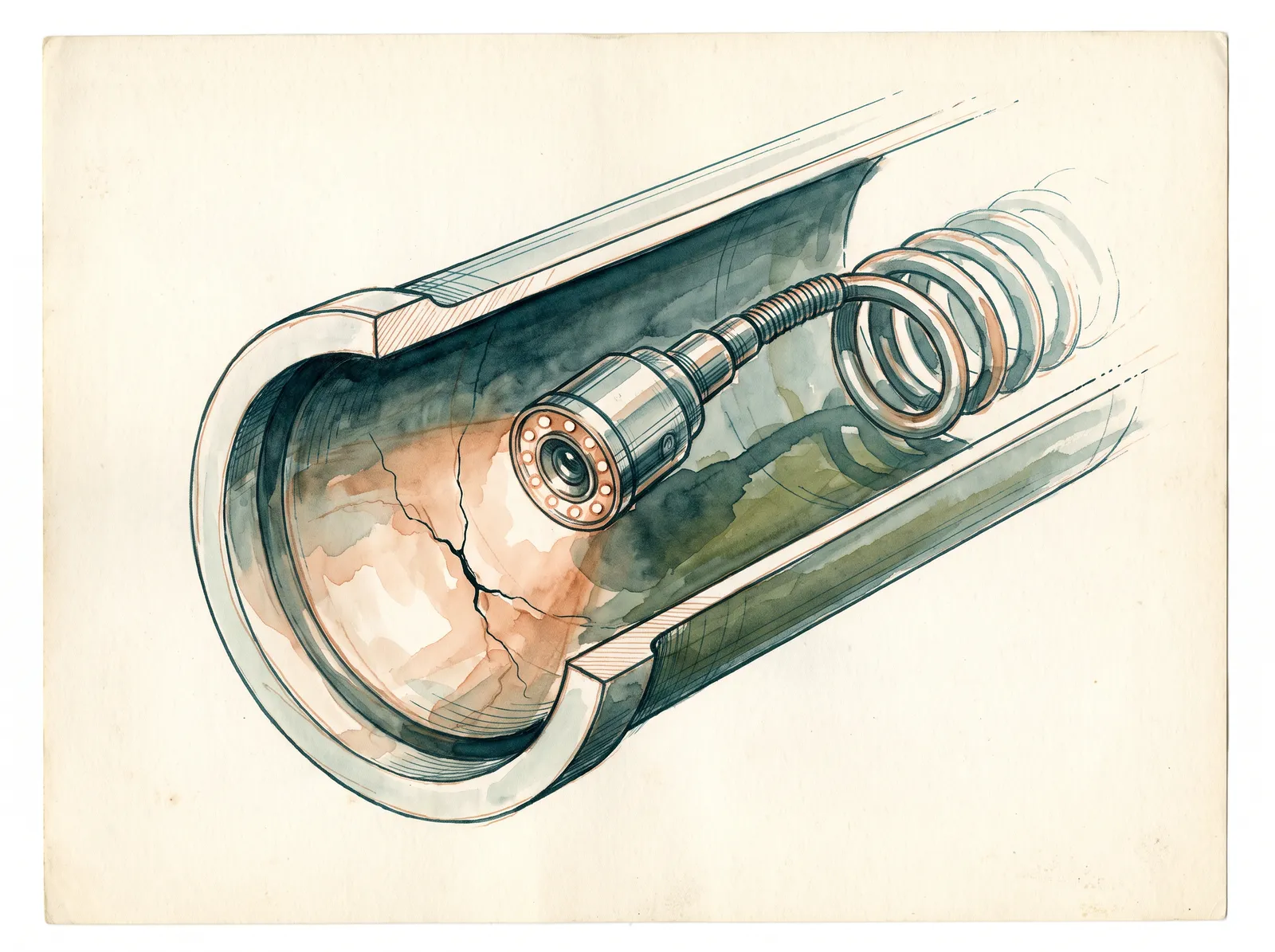
A camera before a promise. A CCTV drain inspection reads the line from inside: what the blockage is, where it sits, and whether the pipe around it is sound, cracked or root-bound. Paired with a locator, it turns "somewhere under the yard" into a mark on the lawn with a depth beside it. Recurring blockages, above all, deserve this before any more clearing; our journal entry on routine drain inspection makes the case that the camera is cheapest exactly when nothing is wrong yet.
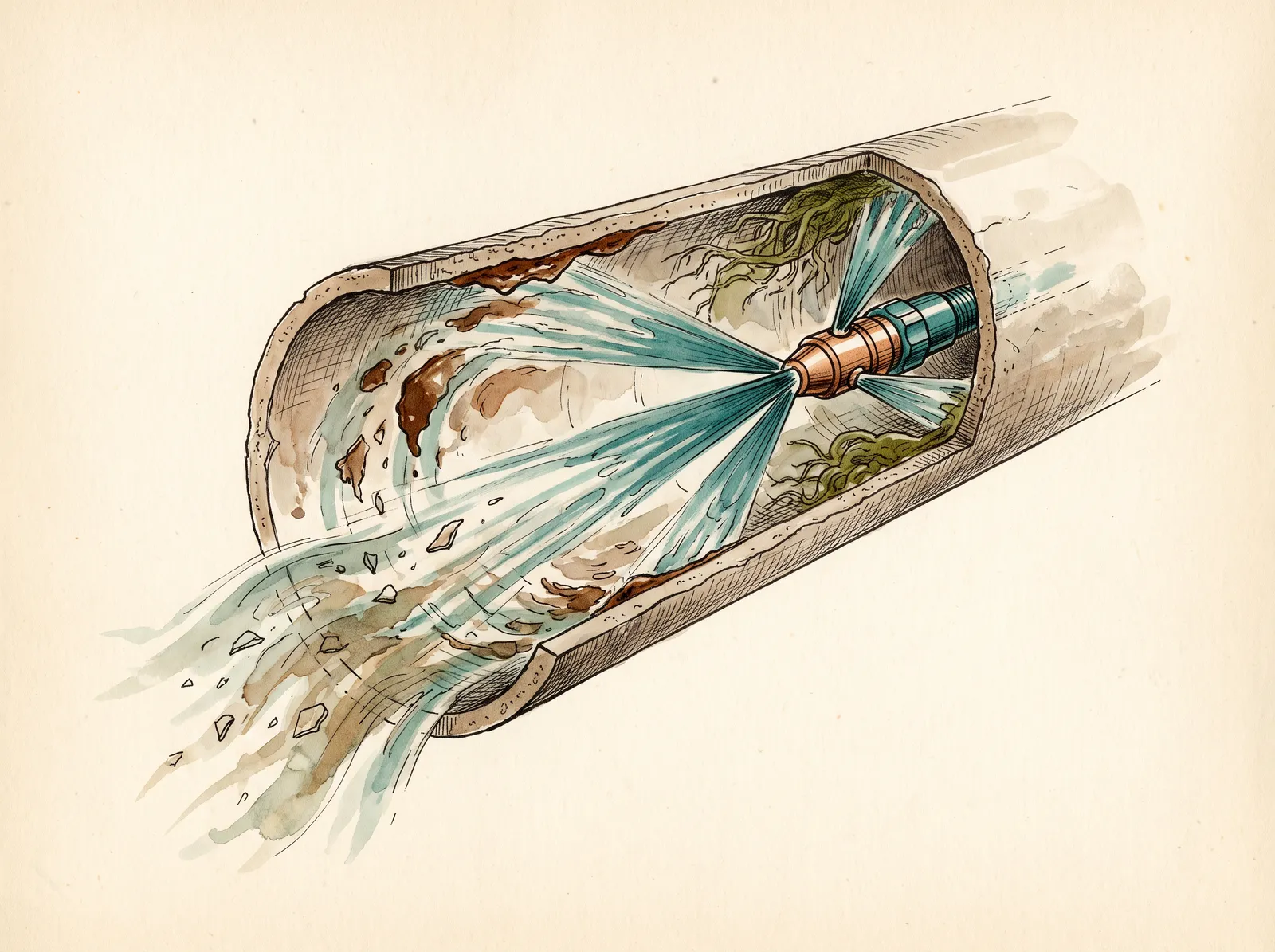
The right clearing tool for the mechanism. An electric drain machine (the professional snake) cuts through root masses and hooks out solid objects. A hydro jetter scours the pipe wall clean with high-pressure water: it is the tool for grease and silt, it restores the full bore rather than punching a hole through the plug, and it uses no chemistry at all, which is why it is the default in any eco-minded drain practice. On fragile old pipe, the camera-first rule is what keeps jetting safe.
A finding, not just a clearing. The job should end with you knowing what blocked the drain and whether it will happen again: a root mass at a specific joint, a bellied section, a grease habit. That finding is what turns an emergency into a maintenance plan.
If you are in Newcastle or the Hunter, this publication's standing pointer for exactly this work is the blocked drain crew at Green Planet Plumbing, who run the camera-and-jetter playbook described above. Elsewhere, ask any prospective plumber two questions: do you camera the line, and do you jet or machine it? The answers tell you whether you are hiring the method or the guess.
One more scenario belongs here because it will not wait for a business card: stormwater backing up in a flood. When the ground is saturated, water finds every path, and no amount of drain clearing beats hydrology. Move what matters above the waterline, never walk or drive through floodwater, and for flood and storm emergencies call the SES on 132 500.
07 Prevention that works
Prevention is mostly the mechanisms from section 02, run backwards, and none of it is expensive.
- Strain everything. A mesh strainer in the kitchen sink and a hair catcher in the shower intercept the two biggest blockage inputs for a few dollars each. Empty them to the bin, not back down the drain.
- Treat fat as a solid. Cool it, jar it, bin it. The pan wipe with a paper towel before washing up is the single highest-value drain habit a kitchen can adopt.
- Flush only the three Ps. Pee, poo, paper. Wet wipes go in the bin regardless of what the packaging promises.
- Run an enzyme dose on a schedule. Monthly, overnight, into the kitchen line: the culture digests the grease film before it becomes the catch-point for everything else.
- Plant with the drain in mind. The wrong tree over a clay line is a subscription to blockages. Species choice and root barriers are covered in the tree root study.
- Inspect before symptoms, if the line has history. Old earthenware, big trees, or a previous root clearing: a periodic camera pass costs little and catches the problem while it is still a note rather than an excavation. The case, with the honest counter-case, is in the inspection entry.
- If you are building or renovating, sensors and smarter layouts can watch the line for you; the journal's study on intelligent drainage systems covers what is real and what is a brochure.
08 Questions, answered
Does bicarb and vinegar actually unblock a drain?
Not an established blockage, no. The fizz is carbon dioxide leaving salt water: pleasant agitation, useful freshening, no meaningful dissolving power against a hair or grease plug. It earns its place as maintenance after a drain has been cleared mechanically. For the plug itself, the plunger and the snake in section 04 are the honest tools.
Why does my bathroom sink gurgle when the washing machine drains?
Because they share a line, and the machine's pump discharge is the most violent flow that line sees all day. If the shared pipe is partially blocked (or its vent is restricted), the slug of water compresses and rarefies the air ahead of and behind it, and the nearest water seal, your sink trap, is where the pressure equalises audibly. One fixture gurgling at another's discharge is a classic shared-line symptom: worth acting on while it is still a gurgle.
Is the blockage my problem or the water utility's?
As a general rule across Australian utilities: the pipes on your property up to the point of connection are the owner's responsibility, and the sewer main beyond it is the utility's. If sewage is surfacing and you suspect the main rather than your line (for instance, neighbours are affected too), call your water utility before paying anyone. If the fault is in the main, the utility attends at its cost.
Can I use caustic soda to clear a drain?
You can buy it, which is not the same question. Section 05 lays out the case: heat where plastic and rubber live, a trap full of caustic solution if it fails, hostile chemistry if it meets other cleaners, and a dead septic culture if you are on one. A blockage that would justify chemistry that strong is a blockage that justifies a camera instead.
How do plumbers find a blockage without digging up the yard?
A CCTV camera goes up the pipe from an inspection opening and shows the blockage directly; a sonde in the camera head transmits its position to a locator above ground. The result is a mark on the lawn and a depth, which is why modern drain work digs (when it digs at all) a neat hole in the right place rather than a trench in search of one.
Is hydro jetting safe for old pipes?
In sound pipe, yes, and it is the cleanest clearing method there is: water only, full-bore result. In compromised pipe (cracked earthenware, open joints), high pressure can worsen the damage, which is exactly why the professional sequence is camera first, then jet. A crew that jets blind into an unknown old line is answering the wrong question quickly.
+ The studies behind this guide
Three journal entries carry this guide's deeper dives, each kept at its original address and date:
09 Check your symptom
The desk below covers this guide's territory. Pick what you are seeing for the mechanism and an honest severity read, then send us the specifics.
The interactive desk needs JavaScript, but the enquiry desk does not: describe what your drain is doing and we will point you in the right direction.
Sources
- YourHome: Reducing water use, the Australian Government's guide to environmentally sustainable homes. The leak and water-waste figures used across this site, including the litres figures quoted by the diagnosis desk, come from this page.
- Plumbing Code of Australia, Australian Building Codes Board. The national framework through which AS/NZS 3500.2 (Sanitary plumbing and drainage) applies to the drainage described in this guide. The standard itself is paywalled; the ABCB page describes its role and scope.
- NSW State Emergency Service. The SES flood and storm emergency number, 132 500, operates across Australian states and territories.
Tell us what your plumbing is doing
Describe the symptom, the fixture and how long it has been going on. We read every enquiry and reply with guidance and a sensible next step. Anything that needs tools is a licensed plumber's job, and we will say so plainly.