Commercial plumbing: the systems, the duties, and who does the work
A house has pipes. A commercial building has pipes plus a set of legal duties that come with putting the public, staff and food near water: backflow that has to be tested, trade waste that has to be treated, hot water that has to be tempered. This guide maps those systems, names the recurring obligations, and is plain about the line between what an owner manages and what only a licensed plumber may touch.
Updated 16 July 2026 · Reading time approx. 18 min
01 What commercial plumbing asks of you
The plumbing in a shop, cafe, office or clinic works on the same two ideas as a home: clean water arrives under pressure, and waste leaves under gravity. What changes on a commercial site is not the physics. It is the number of people relying on the water, the things that water touches (food, chemicals, the public), and a layer of legal duty that a house never carries.
Three parties share a commercial water system, and knowing which is which saves a great deal of confusion when something goes wrong.
You, the owner or facilities manager. Your real job is not plumbing. It is knowing what systems the building has, keeping them on a schedule, keeping the records, and calling the right licensed person before a problem becomes an incident. Most of what follows in this guide is written to that job.
The licensed plumber. In Australia, plumbing and drainage work must be done by a licensed plumber, and several of the tasks on a commercial site (testing a backflow device, servicing a tempering valve, commissioning a grease arrestor, anything on gas) need specific endorsements beyond a general licence. We explain the work; a licensed plumber does it.
The water authority. The utility that owns the main in your street (Sydney Water, Hunter Water, and their equivalents in each state) is not a passive supplier to a business. It sets and enforces trade waste agreements, requires and records backflow testing, and can issue notices, penalties or a disconnection when a property discharges what it should not. On a commercial site the authority is a party to your plumbing, not just the far end of the pipe.
The governing framework
- Design and installation standard
- AS/NZS 3500
- Applied nationally through
- Plumbing Code of Australia
- Who owns the code
- ABCB (NCC Vol. Three)
- All plumbing work is
- licensed work
- Trade waste is agreed with
- your water authority
The AS/NZS 3500 series (water services, sanitary plumbing and drainage, heated water, stormwater) is applied across Australia through the Plumbing Code of Australia. The standards themselves are paywalled; the ABCB describes their scope. See sources below.
02 The systems under the building
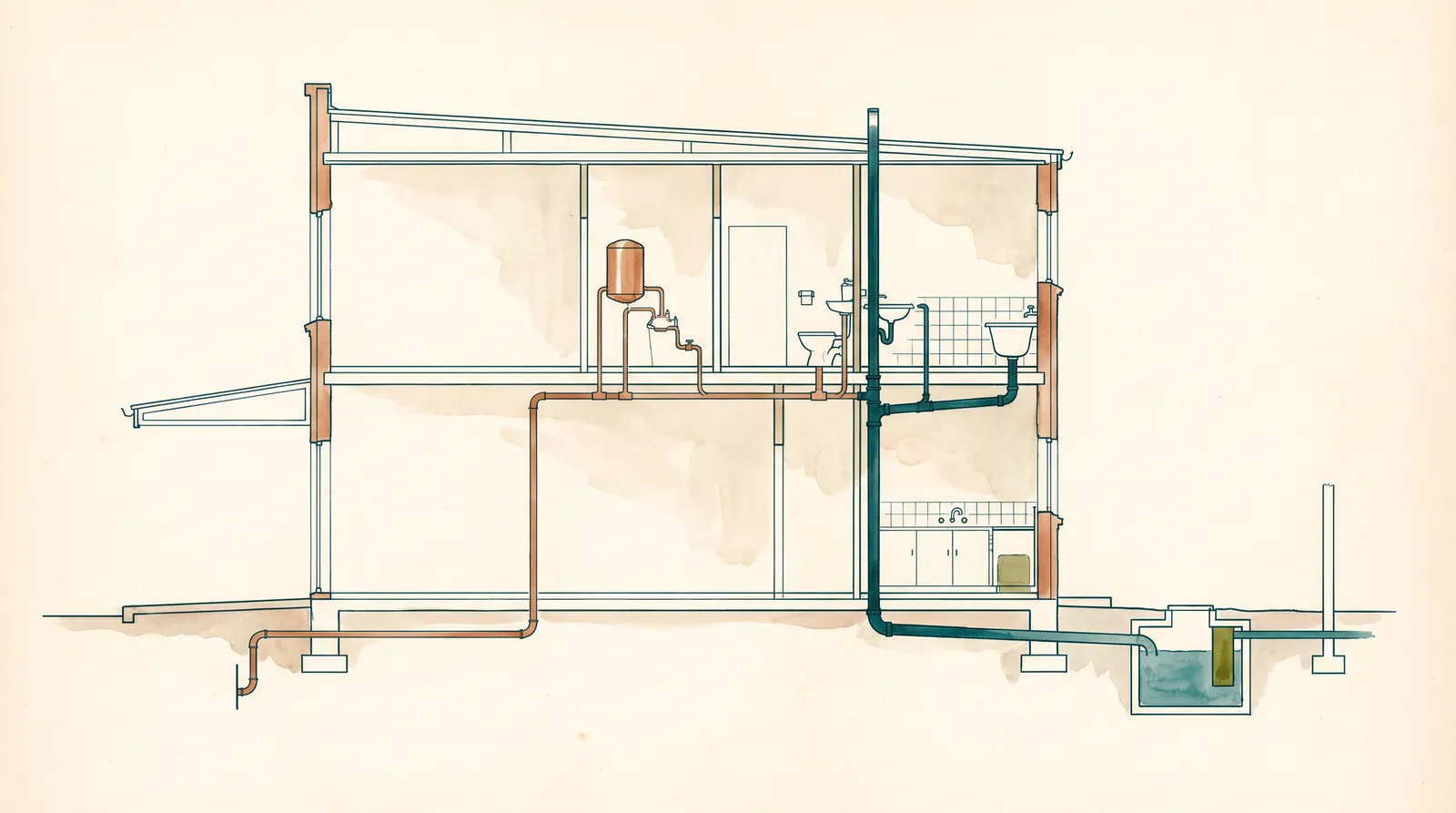
A commercial building carries the same supply and waste as a house, plus a few components a house is not required to have. Three of them do most of the compliance work: a backflow device where the supply enters, a tempering valve on the hot water, and a grease arrestor on any kitchen waste. Everything in this guide hangs off the diagram below.
Getting the layout of these systems right at design stage is its own discipline, and it is where the cheapest savings and the most expensive mistakes both live. The deeper study on planning and designing plumbing systems for office buildings walks through zoning risers, sizing for real peak demand rather than fixture counts on paper, and leaving room to maintain what you install.
The five systems, and who a house shares them with
- Potable (drinking) supply
- protected by backflow
- Heated water
- tempered before delivery
- Sanitary drainage
- gravity to the sewer
- Trade waste
- pre-treated, then agreed
- Stormwater
- separate, never the sewer
A house has the first three. The commercial additions, backflow protection, tempering and trade waste pre-treatment, are the ones with recurring legal duties attached, and the rest of this guide takes them one at a time.
03 Backflow prevention: the duty most owners miss
Backflow is clean water flowing the wrong way: back out of your building and into the public main it came from, carrying whatever it picked up on the way. It happens when the pressure balance that normally pushes water in reverses, either because the main loses pressure (a burst or heavy draw-off nearby pulls water backward, called back-siphonage) or because something inside the building pushes harder than the main (a pump or boiler, called back-pressure).
A house has few ways to contaminate the main. A commercial building has many: a hose dropped in a mop bucket, a chemical dosing line, an irrigation system, a cooling tower, a dental or medical fitting. Each is a cross-connection, a point where clean and dirty water can meet if the flow reverses. The higher the hazard, the more serious the device the authority requires.
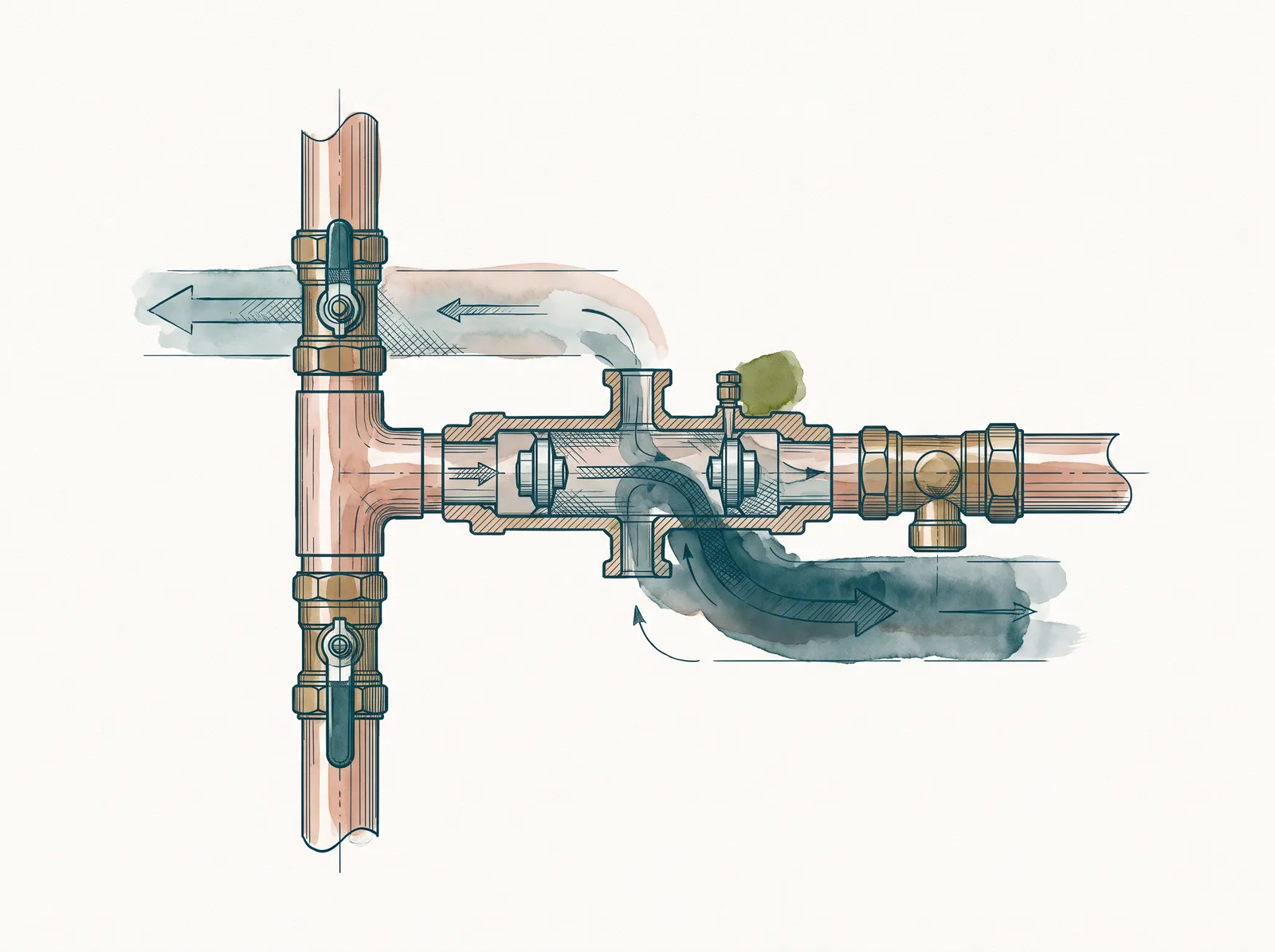
What this means in practice is a short list an owner can actually act on:
- Most commercial connections need a testable device. It sits just inside the boundary, on the incoming main. If you cannot say whether your property has one, that is the first question for a licensed plumber.
- Testable devices are tested every 12 months. The test is done by a plumber accredited specifically for backflow, who lodges the result with your water authority. Miss it and the authority chases it, because the record is theirs, not just yours.
- The device is matched to the hazard. A reduced-pressure-zone device (RPZD) for high hazard, a double check valve for medium, a simpler device for low. Changing what happens in the building (a new chemical line, a new tenant) can change the hazard rating and the device you are required to have.
Installing, testing and maintaining a backflow device is licensed plumbing work, and the annual test must be done by a plumber holding backflow accreditation, not a general handyman. The relevant field-testing standard is AS/NZS 2845.3. Your role as owner is to know the device exists, keep the annual test booked, and keep the certificates.
04 Trade waste and grease arrestors: if you cook, you have a contract
Ordinary household wastewater is called domestic waste, and it flows to the sewer without any agreement. Anything a business sends down the drain that is not ordinary household waste is trade waste, and it needs the water authority's permission before the first drop leaves the property. For a food business, the most important form of trade waste is fats, oils and grease (FOG) from the kitchen.
Warm FOG pours like a liquid and sets like a candle. Sent to the sewer it cools, coats the main, and builds the fatbergs that block whole streets. So the authority requires food premises to hold the FOG back on site, in a grease arrestor: a tank that slows the wastewater down long enough for physics to sort it.
Three things follow from this, and together they are the whole commercial kitchen obligation:
- You need a trade waste agreement. A restaurant, cafe, bakery, takeaway or any premises that cooks needs a signed agreement with the water authority before discharging. The agreement names the arrestor, its size, and the pump-out frequency.
- The arrestor is sized for your kitchen, not off a shelf. Size follows the peak flow and the fixtures draining through it. Undersize it and it stops separating under load; the FOG simply carries through.
- The authority sets the pump-out schedule, and it is enforced. Frequencies commonly run from every few weeks to a few months depending on the arrestor and how hard the kitchen works it, and the pump-out must be done by a licensed liquid-waste transporter who lodges the record. A grease arrestor that is not pumped on schedule is a breach whether or not it has blocked yet.
You cannot service the arrestor yourself, but the housekeeping that keeps it working is yours: fit and empty sink strainers, scrape and dry-wipe pans before washing up, keep a bin for waste oil rather than the drain, and train every new kitchen hand to do the same. Every gram of FOG kept out of the drain is one the arrestor does not have to hold, and a pump-out schedule you can actually meet.
05 Hot water, scalding and the bug in the warm
Commercial hot water carries two opposite risks at once, and the way it is plumbed is the compromise between them. Stored hot water has to be kept hot, around 60 degrees, because the bacterium Legionella breeds in warm water that sits in the 20 to 45 degree range. But water at 60 degrees scalds skin in seconds, which is unacceptable at a basin used by the public, children, patients or the elderly.
The resolution is to store hot and deliver warm. Water is held at a temperature that discourages Legionella, then blended down at the outlet by a thermostatic mixing valve (a TMV, also called a tempering valve) to a safe delivery temperature just before it reaches the tap.
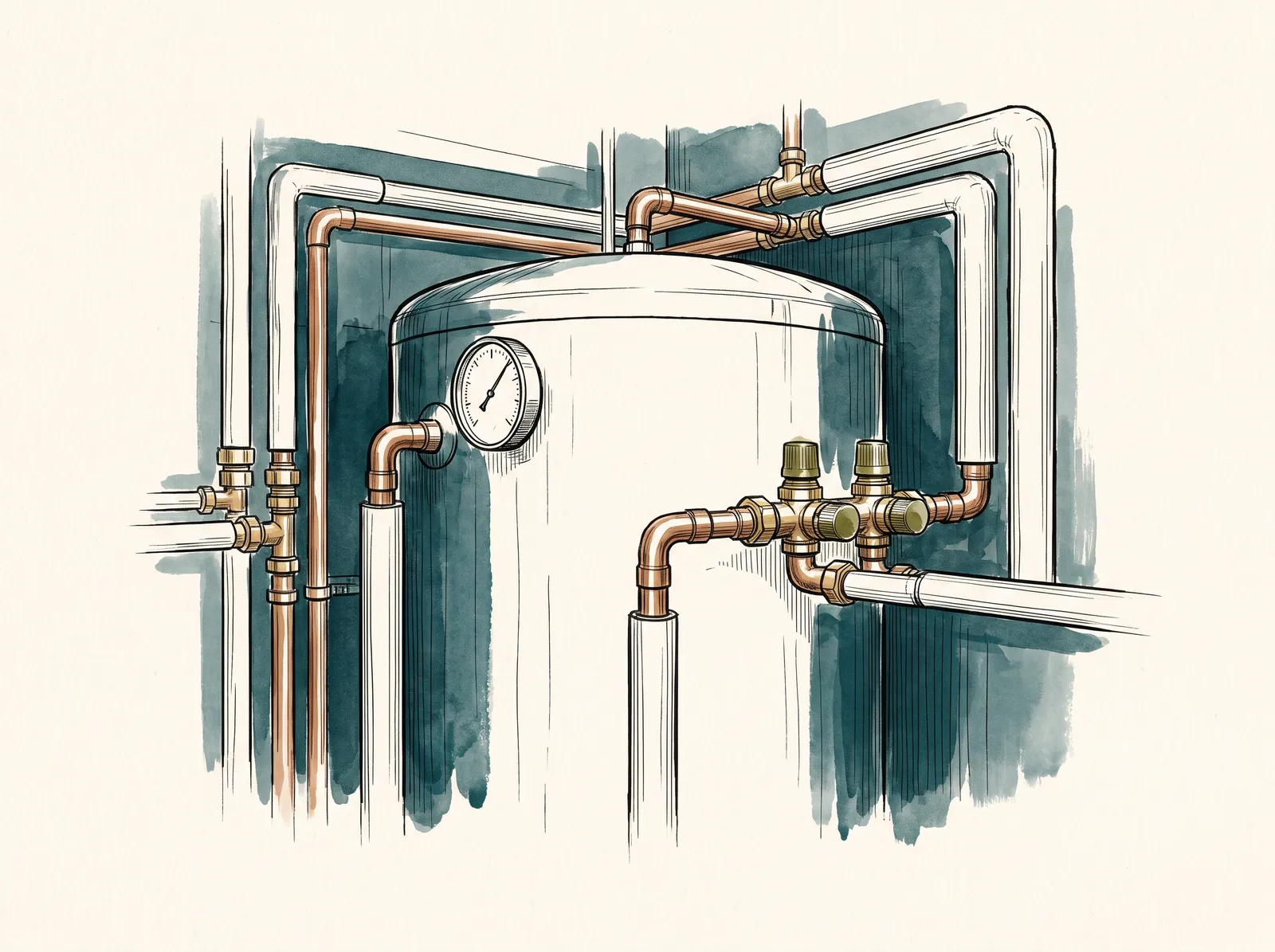
For an owner, the duties here are short and specific:
- Care settings have a hard temperature cap. AS/NZS 3500.4 caps heated water delivered to fixtures used for personal hygiene at 45 degrees in early childhood centres, schools, aged care, healthcare and facilities for people with a disability, and 50 degrees in other buildings.
- Tempering valves are serviced every 12 months. A TMV is a mechanical valve that drifts as it ages, and a drifted valve either scalds or lets the delivery run cold enough to defeat the whole point. The annual service is done by a licensed plumber and, like backflow, it is recorded.
- Warm-water systems and cooling towers need managing, not just plumbing. Any system that deliberately holds water warm (a warm-water ring main in a hospital, a cooling tower on the roof) is a Legionella risk managed under the plumbing standards and your state's public-health rules, with its own testing regime.
06 Accessibility, and getting the Code right
If you are building, renovating or changing the use of a commercial space, the restrooms are not a free design canvas. Accessible sanitary facilities are required by the National Construction Code, and the technical detail (how much clear floor space, how high the pan, where the grab rails sit, how the door swings) comes from an Australian Standard: AS 1428.1, Design for access and mobility.
One honest correction is worth making here, because the internet is full of the wrong version. The American standard is the ADA. It does not apply in Australia, and a fit-out designed to it will not pass. In Australia the reference is AS 1428.1 as called up by the NCC, and the numbers are different.
An accessible unisex sanitary compartment, in the Code's terms, is a specific room: a closet pan and washbasin reachable from a wheelchair, a shelf or bench, a means of disposing of sanitary products, grab rails in defined positions, and enough clear circulation to turn. It has to be reachable without crossing a space reserved for one sex. These are minimums, not aspirations, and they are checked at certification.
Accessibility is cheap on paper and expensive in tiles. The time to resolve an accessible facility is at design, with the plumber and the certifier reading the same AS 1428.1 layout, not after the walls are up and the fixtures are set. A restroom upgrade that ignores it can fail inspection and be rebuilt at full cost.
07 Water efficiency, the obligation that pays back
Every duty so far in this guide costs money to meet. Water efficiency is the one that returns it, because in a commercial building water is a metered running cost and most buildings waste a surprising amount of it through fixtures and habits that were never examined.
The national tool for choosing better fixtures is the WELS scheme (Water Efficiency Labelling and Standards): the star rating and litre-per-use figure on taps, toilets, urinals and other products. More stars is less water for the same job, and on a commercial site with dozens of fixtures the difference compounds fast. The measures that actually move a building's water bill, roughly in order of return:
- Fix the leaks you cannot see first. A running urinal or a failed cistern valve can quietly out-waste every efficiency upgrade you make. Sub-metering and simple overnight-flow checks find them: if water moves through the meter when the building is empty, something is leaking.
- Right-size the flush and the flow. High-WELS tapware, dual-flush pans and sensor or timed taps in public restrooms cut the litres per use without anyone noticing a worse experience.
- Consider waterless where it fits. Waterless urinals remove a whole category of flush water in the right building; they trade water for a maintenance routine, so they suit some sites and not others.
- Regulate pressure and reuse where the building allows. A pressure-limiting valve stops every fixture over-drawing; rainwater for landscape irrigation or toilet flushing, and greywater reuse, turn a cost into a supply where the plumbing and the approvals support it.
None of this is guesswork you have to do alone. A water audit by a licensed plumber measures where the water actually goes before anyone spends on fixtures, which is the difference between an efficiency project that pays back and a catalogue of good intentions.
08 Yours to do, or always a licensed plumber
The residential guides on this site have a real do-it-yourself chapter, because a homeowner can safely plunge a sink or replace a tap washer. On a commercial site that chapter is almost empty, and pretending otherwise is how people get hurt and businesses get fined. The honest division of labour looks like this.
Yours to do, and worth doing well
- Know where the main stop valve and each isolation point is, and that they turn.
- Keep the schedule: backflow test, TMV service, grease arrestor pump-out, all booked before they fall due.
- Keep the records and certificates where the certifier or authority can see them.
- Housekeeping: sink strainers, dry-wiping pans, a waste-oil bin, staff trained on all of it.
- Read the sub-meter, watch for overnight flow, log what changes.
- Report a symptom early, with detail: which fixtures, how long, what you have noticed.
Always a licensed plumber, no exceptions
- Any work on pipes, fixtures or drainage, connecting, altering or repairing.
- Backflow device testing and maintenance (needs backflow accreditation).
- Tempering valve service and any hot-water work.
- Grease arrestor installation and commissioning; the pump-out itself needs a licensed liquid-waste transporter.
- Anything on a gas appliance or gas line (a separate licence again).
- Anything that changes a backflow hazard rating or a trade waste discharge.
The pattern is worth stating plainly: on a commercial site the owner's job is to notice, schedule and record, and the plumber's job is to touch the water. Several of the plumber's tasks need a specific accreditation on top of a plumbing licence, so the right question to a contractor is not just "are you licensed" but "are you accredited for this particular job".
09 What getting it wrong actually costs
The duties in this guide can read like box-ticking until one of them lapses. The costs are rarely a single repair bill; they compound across compliance, money, health and the ability to trade. In rough order of how fast they escalate:
The stakes, by system
- Backflow lapses
- contamination, authority notice
- Grease arrestor unpumped
- trade waste breach, blocked main
- TMV drifts
- scald injury, or Legionella risk
- Restroom not to Code
- failed certification, rebuild
- Records missing
- insurer and authority both ask
These are the general consequences the standards and water authorities describe; the specific penalties sit with your authority and insurer. We do not quote figures because there is no honest single number.
Two of these deserve a plain word. A backflow contamination event is not just your problem: it can pollute the shared main and reach neighbours, which is why the authority treats a missed test seriously rather than as paperwork. And a failed accessibility fit-out is uniquely expensive because it is discovered late, at certification, when the walls and tiles are already in and the fix means opening them back up.
The through-line is that almost every expensive commercial plumbing failure was a scheduled, knowable task that slipped. Which is the argument for the last section.
10 The maintenance calendar that prevents it
Nearly everything in this guide is a recurring obligation with a known interval. Written down as a planned maintenance calendar, the whole compliance burden of a commercial building becomes a short list of dates rather than a series of surprises. This is the single most useful thing an owner or facilities manager can hold.
A planned maintenance schedule is also the cheapest insurance you own. It keeps the certificates current for your insurer, it catches the drifted valve and the tired arrestor before they become the incident, and it turns "we think a plumber looked at that once" into a dated record. If your building does not have one written down, that is the single highest-value thing to fix, and a licensed plumber who works on commercial sites can build it around what you actually have.
11 Questions, answered
Do I really need a backflow prevention device?
Most commercial connections do, because commercial buildings hold far more ways to contaminate the main than a house: hoses, chemical lines, irrigation, cooling towers, medical or dental fittings. The device required is matched to the hazard, and if a testable device is fitted it must be tested every 12 months by a backflow-accredited plumber who lodges the result with your water authority. The honest first step is to confirm with a licensed plumber whether your property has one and when it was last tested.
How often does the grease arrestor have to be pumped out?
Your water authority sets the frequency in your trade waste agreement, and it depends on the size of the arrestor and how hard your kitchen works it. In practice it commonly ranges from every few weeks to a few months. The pump-out has to be done by a licensed liquid-waste transporter, and a missed pump-out is a breach whether or not the arrestor has blocked yet. Good kitchen housekeeping (strainers, dry-wiping, a waste-oil bin) is what keeps that interval manageable.
Who is responsible, the tenant or the landlord?
That depends on your lease, and it is worth reading before something fails rather than after. As a general pattern, fixed infrastructure (the backflow device, the grease arrestor, the hot water plant) tends to sit with the building owner, while the trade waste agreement and the day-to-day discharge tend to follow the business that generates the waste. The water authority, though, will pursue whoever the account and the agreement name, so both parties benefit from knowing exactly who holds each duty.
Can my handyman service the tempering valve or test the backflow?
No. Both are licensed plumbing work, and both need a specific accreditation on top of a plumbing licence: backflow testing requires backflow accreditation, and tempering-valve and hot-water work requires a licensed plumber. The results of both are recorded and, for backflow, lodged with the authority. A handyman cannot issue the certificate your insurer and the authority will ask for.
Is my restroom compliant if it looks accessible?
Looking accessible and meeting AS 1428.1 are different things. The standard sets specific dimensions for clear floor space, pan and basin heights, grab-rail positions and door approaches, and a certifier checks them against the drawing. Be especially wary of any fit-out designed to the American ADA standard, which does not apply in Australia and will not pass. Resolve accessibility at design stage with the plumber and certifier reading the same AS 1428.1 layout.
Why is commercial hot water stored so hot if it can scald?
Because the two risks pull in opposite directions. Water held in the warm range, roughly 20 to 45 degrees, can grow Legionella, so stored hot water is kept hot (around 60 degrees) to discourage it. That storage temperature scalds, so a thermostatic mixing valve blends it back down at the outlet to a safe delivery temperature. The valve is a safety device that drifts as it ages, which is why the Code requires it to be serviced every 12 months.
We are only doing a small fit-out. What actually triggers all this?
Changing what happens in a space can change its plumbing duties even when the footprint stays the same: a new food use triggers a trade waste agreement and a grease arrestor, a new chemical or irrigation line can change the backflow hazard rating, and any restroom work brings the accessibility provisions into scope. The reliable move is to raise the plumbing and compliance questions at design, with a licensed plumber and your certifier, before the first wall goes up.
+ The study behind this guide
One journal entry carries this guide's deeper dive, kept at its original address and date. For the systems that sit sideways to commercial work, the two neighbouring guides pick up where this one stops.
12 Check your symptom
The two commercial symptoms most worth reading early both start in the kitchen: a drain that is slowing as grease builds, and a smell that means a seal or a build-up. Pick what you are seeing for the mechanism and an honest severity read, then tell us the specifics of your site.
The interactive desk needs JavaScript, but the enquiry desk does not: describe what your building's plumbing is doing and we will point you toward the right licensed specialist.
Sources
- Plumbing Code of Australia, Australian Building Codes Board. The national framework (NCC Volume Three) through which the AS/NZS 3500 series applies to the water, drainage, heated water and stormwater systems described in this guide, and which calls up AS/NZS 2845 for backflow and AS/NZS 3500.4 for tempering. The standards themselves are paywalled; the ABCB describes their role and scope.
- Retail food trade wastewater, Sydney Water. An example of a state water authority's trade waste requirements: the agreement a food business must hold before discharging, the grease arrestor obligation, and the authority-set pump-out schedule. Your own authority (for example Hunter Water) publishes the equivalent for its area.
- NCC Part F4, Sanitary and other facilities, Australian Building Codes Board. The Code provision requiring accessible sanitary facilities, which references AS 1428.1 (Design for access and mobility) for the technical detail of an accessible compartment.
- Water Efficiency Labelling and Standards (WELS), Australian Government. The national scheme behind the star rating and litre-per-use figure on taps, toilets and urinals used in the water-efficiency section.
- YourHome: Reducing water use, the Australian Government's guide to environmentally sustainable homes, and the source of the general water-waste framing used across this site.
Tell us what your plumbing is doing
Describe the symptom, the fixture and how long it has been going on. We read every enquiry and reply with guidance and a sensible next step. Anything that needs tools is a licensed plumber's job, and we will say so plainly.