Routine drain inspection for early problem detection
A drain almost never fails on the day it stops. It narrows for months and cracks quietly for years, and the whole point of a camera is that it can read that story while the pipe is still sound enough to save cheaply. Inspection is at its most valuable exactly when nothing seems wrong.
Published 14 March 2024 · Reading time approx. 8 min
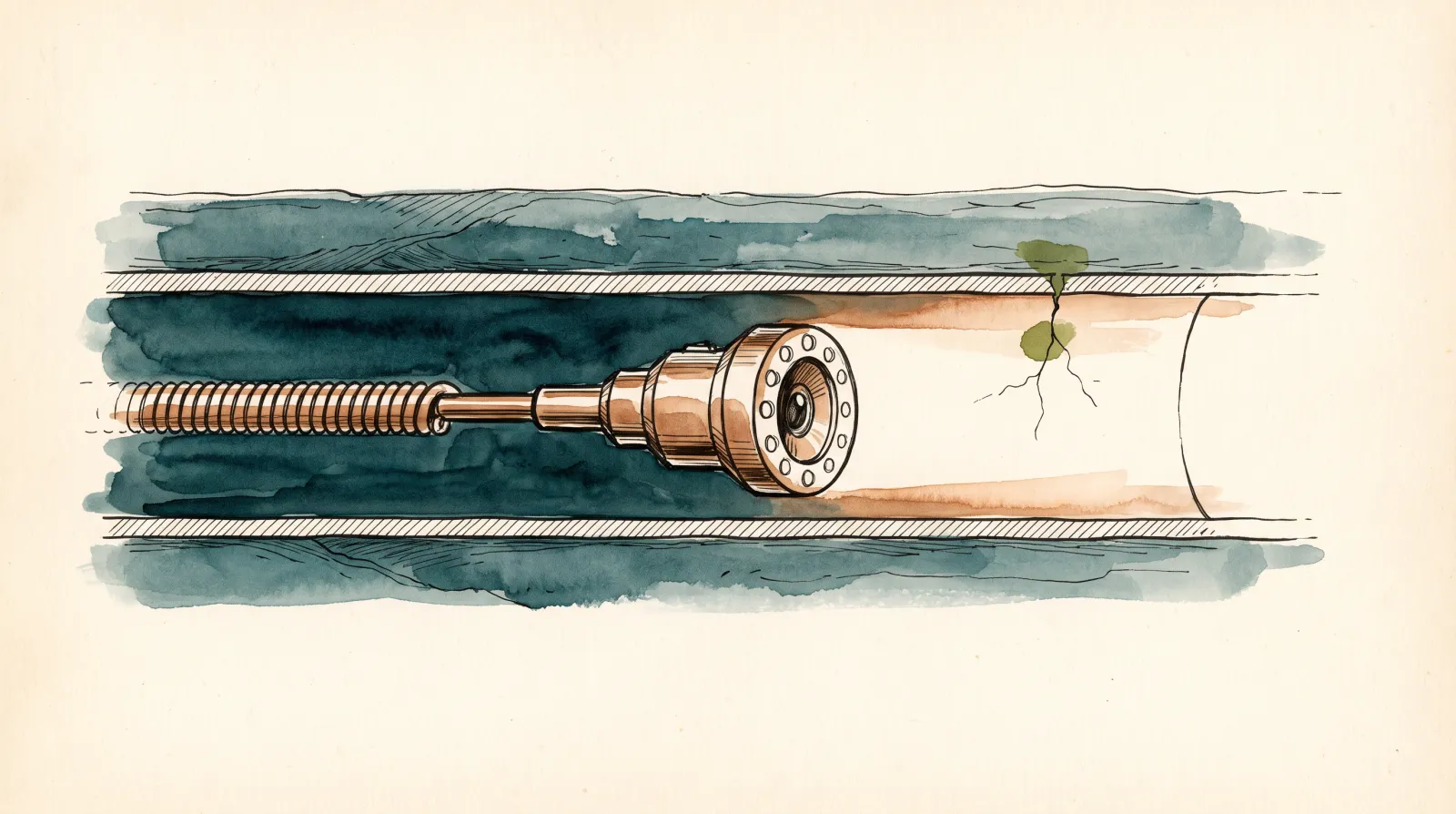
Most drainage problems announce themselves late. By the time a sink is slow or a gully is overflowing, the cause has usually been building for a long time: a grease film thickening, a joint opening a fraction as the ground moves, a root that found a crack two summers ago. A drain inspection is simply the act of looking before the symptom, and it changes the economics of the whole thing. A fault found early is a note in a report; the same fault found late is a blocked line, a wet garden, and sometimes an excavation.
What an inspection actually involves
There are three levels of looking, and only one of them is the real tool.
A visual check is what you and a plumber can see without equipment: the gully grates, the fixtures, the ground above the line for damp or subsidence, and the vocabulary of signs (slow drainage, gurgling, smells). It is useful for deciding whether to look deeper, and useless for telling you what is actually inside the pipe.
A CCTV drain camera is the inspection that matters. A small, often self-levelling camera head is fed along the pipe on a flexible push rod, sending high-definition video back to a monitor above ground in real time. The operator watches the bore go past and sees exactly what is there: a grease band, a root mass, a hairline crack, an open joint, a section that has bellied so water pools in it. A transmitter in the camera head, called a sonde, lets a locator wand on the surface mark the position and depth of anything found, so a problem stops being "somewhere under the yard" and becomes a spot on the lawn with a number beside it.
A professional assessment is the camera plus the judgement to read it: whether that crack is cosmetic or structural, whether the belly is bad enough to catch solids, whether the root ingress needs cutting now or watching. In Australia this is licensed work, and the reading is as much of the value as the footage.
The camera is cheapest precisely when nothing has failed. Reading a sound pipe takes an hour and finds the small problems while they are still small. Reading a pipe that has already stopped means clearing it first, working around sewage, and often discovering that the cheap fix passed months ago. Inspection is insurance, and insurance is bought before the event.
What a camera finds, and why it is non-invasive
The reason the camera changed drain work is that it replaced digging with looking. Before it, finding a fault meant excavating in search of one; now the pipe is read from the inside and, if digging is needed at all, it is a neat hole in the located spot rather than a trench of guesses. Nothing is disturbed to inspect, so there is no damage to the garden, no disruption, and no cost of putting things back.
A good pass typically surfaces one of a handful of things: a build-up (grease, silt, foreign objects) that clearing will fix; root ingress at a joint, which points to the pipe as much as the tree and is covered in our study on tree root intrusion; cracks and open joints that let roots and groundwater in; a bellied or sagged section where the fall has been lost; or simply confirmation that the line is sound and the problem is elsewhere. Each of those is a different job, and the camera is what tells them apart before anyone commits to a repair.
The finding is the deliverable
An inspection worth paying for ends with more than "we had a look". It ends with a finding: what the fault is, where it sits, how deep, and whether it will recur, ideally with the footage and a short written summary. That record is what turns a one-off scare into a maintenance plan, and it is what a future plumber, or a buyer's conveyancer, can actually use. When choosing who does the work, two questions sort the method from the guess: do you camera the line, and do I get the footage and a written finding. A yes to both is a plumber selling you information; anything less is selling you a clearing.
When a routine pass earns its keep
Not every drain needs periodic inspection. It earns its place where the line has history or the stakes are high:
- A drain with a past. Old earthenware, a line that has been cleared of roots before, or repeated blockages in the same spot: these are pipes worth watching, because the next mass is a question of when, not if.
- Big trees over the line. A mature, thirsty tree near the drain makes a camera pass every year or two cheap insurance against a root blockage in the wrong week.
- Before buying an older home. A pre-purchase drain camera is one of the better small spends in a property inspection; a collapsed or root-bound sewer is expensive and entirely invisible from the surface.
- Before and after major works. A renovation, a new driveway, or landscaping over the line is worth a before-and-after look, so that any damage is found while responsibility is still clear.
How the technology is changing
The push-rod camera is still the right tool for a suburban house drain, but the field around it is moving, and it is worth knowing what is real from what is a brochure. At the larger end, utilities and asset managers now use laser profiling and sonar to measure the shape of big or partly-full mains, robotic crawlers to travel long runs, and software that assigns a standard condition grade to each fault from the footage, so that thousands of kilometres of sewer can be prioritised consistently. Machine-assisted defect coding, where a model flags and classifies cracks and joints for a human to confirm, is genuinely arriving in that world.
Almost none of that is something a household buys. A digital twin of a city's stormwater network is civic infrastructure, not a home service, and the honest read for a house is that a good camera and an experienced operator will tell you everything you need to know about your line. The automated, always-on version of drain monitoring belongs to municipal scale; the home equivalent is a periodic pass, and, for the plumbing more broadly, the leak-and-flow monitoring covered in our study on intelligent drainage systems.
Who does the looking
Drainage work in Australia is licensed work, and drain inspection sits inside it. The camera, the reading and any clearing or repair that follows are a licensed plumber's job, and where the fault reaches the point of connection or the tree that caused it, an arborist or your water utility may be involved too. We explain what the inspection is and what it can find; a licensed plumber carries it out.
Chasing a blockage that keeps coming back, or wondering whether an older line is worth a camera pass? Tell us what your drain is doing and we will help you weigh it up.
Sources
- Sydney Water: Wastewater blockages. Names tree roots as the most common cause of wastewater blockages and sets out who is responsible for the pipes on a property, context for why an inspection that locates a fault precisely is worth having.
- Plumbing Code of Australia, Australian Building Codes Board. The national framework through which AS/NZS 3500.2 (Sanitary plumbing and drainage) applies, and the reason drain inspection and repair are licensed work.
- YourHome: Water, the Australian Government's guide to environmentally sustainable homes. Context for maintaining a household water system rather than replacing it after failure.