Blocked drains: what causes them, what not to flush, and whose pipe it is
Most household drain blockages trace back to three things, two of which are decided at your sink and toilet, and knowing where your pipes stop being your problem saves an argument later.
Published 27 September 2026 · Reading time approx. 10 min
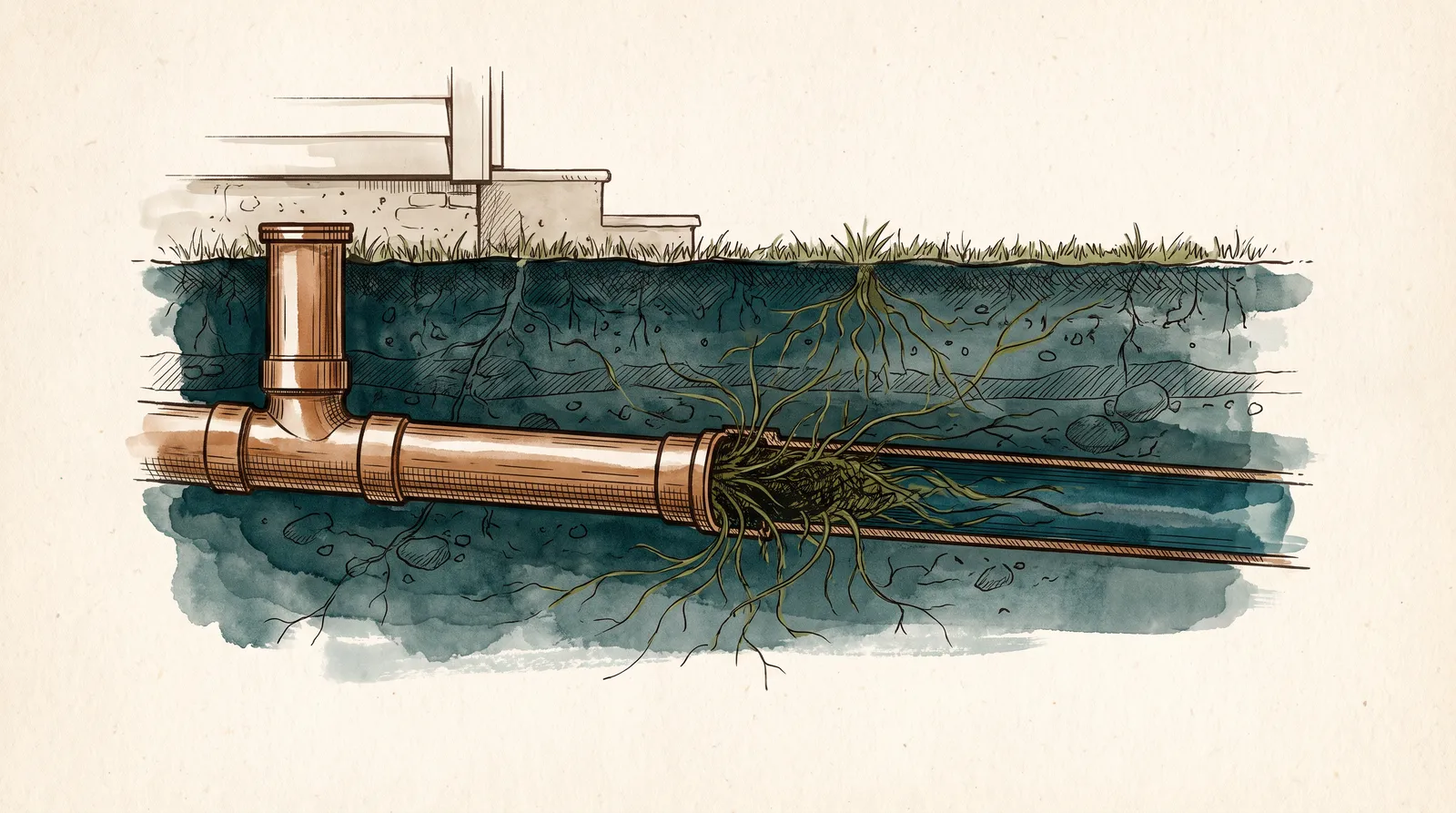
Most blocked drains are not bad luck. Wherever you live in Australia, your local water authority will name the same short list of causes: things flushed that should have gone in the bin, fat poured down the sink, and tree roots finding their way into the pipe.
Your local water authority is also the place to check the local rules: who owns which part of the pipe, and how to report a blockage in the sewer main. Who that is depends on where you live:
- NSW: Sydney Water across Sydney, the Illawarra and the Blue Mountains, Hunter Water across the lower Hunter, and local councils in much of regional NSW
- Victoria: Greater Western Water, South East Water or Yarra Valley Water in Melbourne, and a regional water corporation elsewhere
- Queensland: in south-east Queensland, Urban Utilities (Brisbane, Ipswich, Lockyer Valley, Scenic Rim and Somerset), Unitywater (Moreton Bay, the Sunshine Coast and Noosa), or the council itself on the Gold Coast, in Logan and in the Redlands; your local council elsewhere
- South Australia: SA Water
- Western Australia: Water Corporation
- Tasmania: TasWater
- ACT: Icon Water
- Northern Territory: Power and Water Corporation
Two of those three causes are decided in your kitchen and bathroom. The third is decided by what is planted near your drain line. That is the good news in this article.
What actually blocks a household drain
A blockage is rarely one dramatic object. It is usually a slow build that finally catches something. Goulburn Valley Water in Victoria lists wet wipes, nappies, sanitary items, fats, oils and grease, and tree roots as the common causes of sewer blockages, and that list holds across the country.
| Cause | Where it starts | Typical early sign | What reduces the risk |
|---|---|---|---|
| Non-flushables (wet wipes, nappies, sanitary items) | The toilet | The toilet empties slowly or gurgles | Bin them; flush only toilet paper |
| Fats, oils and grease | The kitchen sink | The kitchen sink drains a little worse each month | Cool the fat into a jar or tin and bin it; wipe greasy pans with paper towel first |
| Tree roots | A joint or crack in the buried drain line | More than one fixture slowing, or blockages returning to the same spot | Keep thirsty trees clear of the drain line; have cracked pipe repaired |
Wipes are the classic starter: they do not break up the way toilet paper does, so they snag on a joint or a root and then collect everything that follows. Fat is the opposite problem, arriving as a liquid and setting hard as it cools in the pipe. Roots are the patient one, growing toward the moisture in a sewer line and widening any crack they find.
If your place has mature trees or a garden bed sitting over the drain line, read our guide to preventing tree root intrusion in drainage systems alongside this page.
What never goes down the toilet or the sink
Lower Murray Water publishes one of the clearest versions of this list, and it is worth pinning inside a cupboard door.
Do not flush or pour
Items 1 to 7: Lower Murray Water, sewerage and trade waste. Item 8: Goulburn Valley Water, sewer blockages. Ticking is for your own use only; nothing is recorded or sent.
The line that surprises people most is the first one. Lower Murray Water says not to flush wet wipes, "even products marketed as flushable", along with paper towels or face tissues, cotton buds, nappies, condoms, tampons, pads or their wrappers, and non-biodegradable products.
Wet wipes, even products marketed as flushable.
Lower Murray Water
Add fats, oils and grease to that list for the kitchen sink, per Goulburn Valley Water. Pour cooled cooking fat into a jar or an old tin and bin it. Wipe greasy pans with paper towel before washing them.
Whose pipe is it: yours or the water authority's
This is where a stressful morning turns into a confusing one. The short answer is that the pipework on your side of the connection point is yours to maintain.
Central Coast Council in NSW spells out the homeowner's duties: maintain and repair all pipework from the point of connection on your property, and ensure the overflow gully is not obstructed. Beyond that connection point, the sewer main is the authority's responsibility.
owner maintains
- Sink and toilet, indoor fixtures
- House drain, laid on a fall
- Overflow relief gully, in the yard
- Point of connection, at the property boundary
How we worked this out: Central Coast Council (NSW), sewer blockage fact sheet (PDF), for the homeowner's duties, the point of connection and the overflow gully.
That split is set locally, so the exact boundary and the process for reporting a blockage vary between water authorities and councils. Check your own retailer's or council's page before you assume. The principle, though, travels: the pipes under your house and yard are part of your property, the same way the roof is.
The gully outside is your early warning system
The overflow relief gully is the grated outlet, usually in a garden bed or paved area outside the house, set lower than your lowest indoor fixture. When a blockage pushes wastewater back up the line, the gully is designed to let it surface outside rather than inside. Queensland's building regulator, the QBCC, publishes dedicated guidance on overflow relief gullies for that reason.
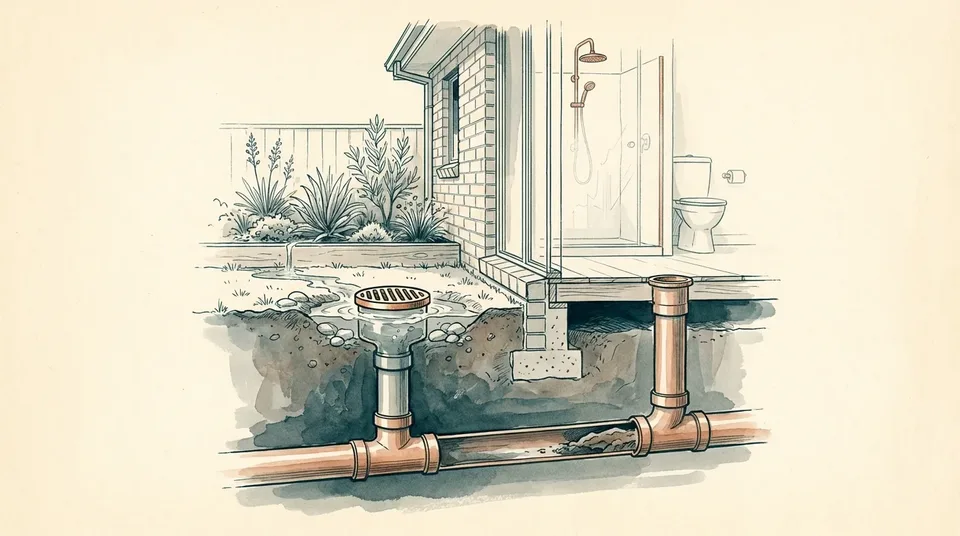
It only works if it can work. Central Coast Council's homeowner duties include keeping the overflow gully unobstructed. Mulch heaped over the grate, a pot plant parked on top, a new deck built across it, or a garden bed raised above the grate level all defeat the design. Walk out and look at yours this weekend.
Signs worth acting on before the next load of washing
A blockage almost always gives notice. The trick is noticing it while it is still one slow fixture and not a backed-up bathroom.
Early warnings worth acting on
Source: Goulburn Valley Water, sewer blockages. Ticking is for your own use only; nothing is recorded or sent.
Pay particular attention when more than one fixture misbehaves at once. A single slow basin is usually a local problem in that trap. A slow shower, a gurgling toilet and a laundry that empties badly all in the same week points further down the line, toward the shared drain.
Check it yourself: which fixtures are slow?
Go through the house and note every fixture that is slow to drain, gurgling or backing up: kitchen sink, bathroom basin, shower, bath, toilet, laundry tub and floor waste. Then look at the overflow gully outside. What you find usually points to one of three situations.
Tick what's slow, gurgling or backing up
Ticking is for your own use only; nothing is recorded or sent.
Just one fixture is slow. That usually means a local blockage in that fixture's own trap or waste pipe. What to do next: clear it at that fixture. Plunge it, pull the hair out of a shower waste, or take the sink trap apart with a bucket underneath. Skip the chemical drain cleaners. If it keeps coming back, have a licensed plumber look at it.
Several fixtures are slow, or the low ones are playing up together (shower, floor waste, toilet). That usually means the blockage is further down the line, in the shared drain. What to do next: stop running water through the house and go and check the overflow gully outside. This is beyond a plunger. It is a job for a licensed plumber, and if the blockage turns out to be past your connection point, for your water authority.
The gully is overflowing, or sewage is coming up inside. That means the drain is blocked now. What to do next: stop using water, keep people and pets away from the overflow, and get a licensed plumber. If you think the problem is in the sewer main rather than your pipes, report it to your local water authority. See whose pipe it is, above.
If you track your water use through a smart meter or an alerting system, that data can be useful here too. We cover the household side of that in our piece on intelligent drainage systems for smart homes.
Where the line sits between a plunger and a licensed plumber
Plenty of first-response work is fair game for a homeowner: plunging a toilet, clearing a hair clog from a shower waste, lifting the grate and pulling leaf litter out of a gully, pulling a sink trap apart with a bucket underneath.
Drainage work proper is a different matter. In NSW, it is a breach of the Home Building Act 1989 to carry out plumbing, draining or gasfitting work without a licence or certificate. Every state and territory regulates this work in its own way, and the same principle applies across the country: regulated plumbing and drainage must be done by a licensed plumber.
| Reasonable to try yourself | Regulated plumbing or drainage work |
|---|---|
| Plunging a toilet | Cutting into a drain |
| Clearing a hair clog from a shower waste | Repairing a cracked section |
| Lifting the grate and pulling leaf litter out of a gully | Altering pipework |
| Pulling a sink trap apart with a bucket underneath | Clearing a blockage in the buried shared drain |
In NSW it is a breach of the Home Building Act 1989 to carry out plumbing, draining or gasfitting work without a licence or certificate. Every state and territory regulates this work in its own way.
There is a practical reason beyond the legal one. Cutting into a drain, repairing a cracked section or altering pipework without the right licensing can leave you with work that will not pass inspection and may complicate a later sale or insurance claim.
The short version
Most of what blocks a drain is decided before it reaches the pipe: what goes in the bin instead of the toilet, where the cooled fat ends up, and what gets planted over the drain line. The gully outside is your warning light, so keep it clear. And the connection point is where your job ends and your water authority's begins.
For the overview of all of this, start with our blocked drains guide. If something at your place doesn't fit what's written here, the enquiry desk takes questions.
Not sure whether what you are seeing is one slow fixture or the shared drain? Describe it to us and we will help you read it.