Water literacy at home: your meter, your star ratings and your local rules
Three plain skills, reading your own meter, reading a WELS label and knowing the water rules that apply where you live, tell you more about your household's water than any single bill does.
Published 12 October 2026 · Reading time approx. 7 min
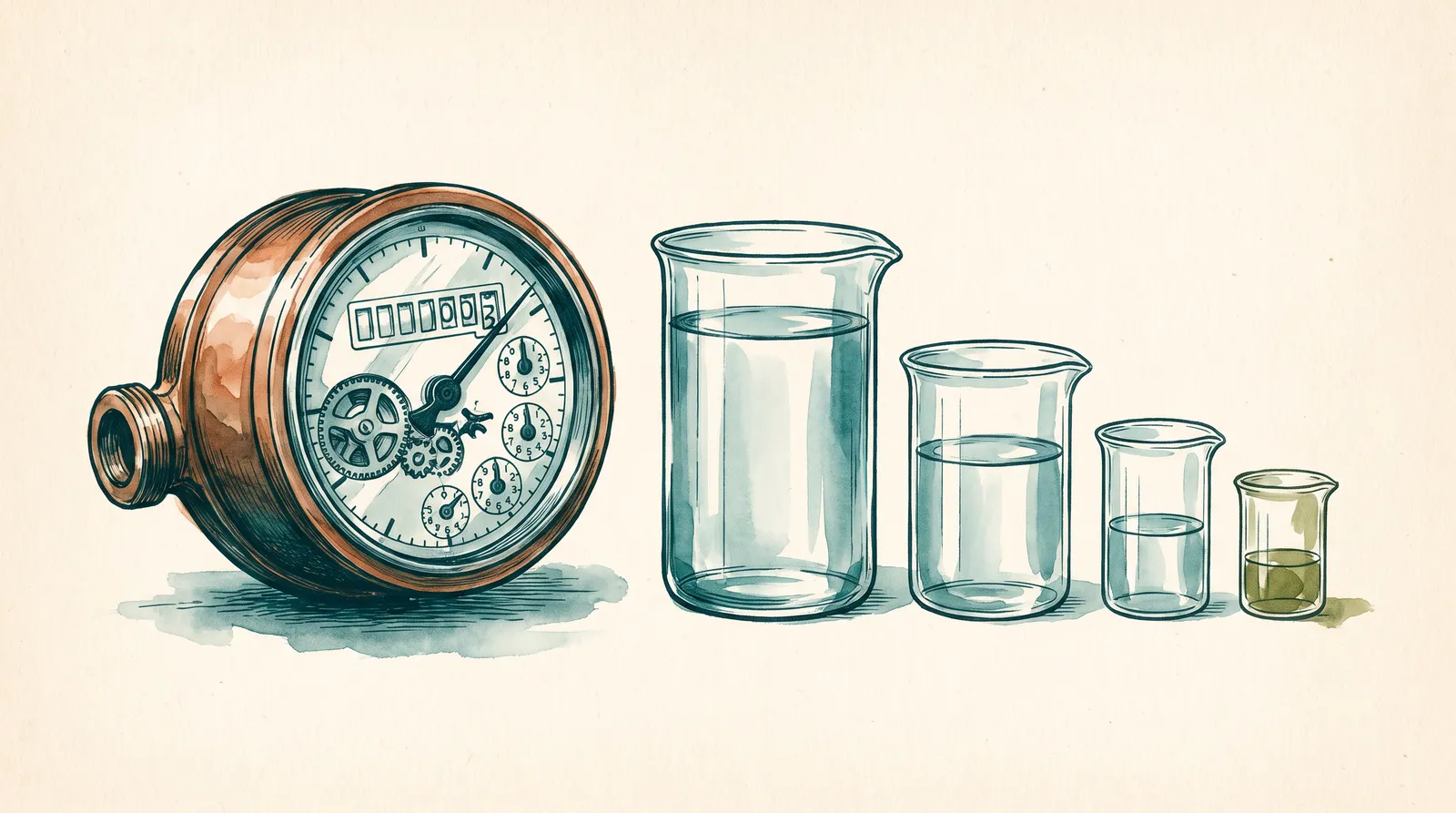
The fastest way to understand your household's water is not the bill. It is three things you can learn in an afternoon: read your own meter, read a WELS star label before you buy, and find out which water rules apply at your address every day of the year. Do those three and a surprising bill stops being a mystery.
There is a dated reason to do it now. National Water Week runs from 19 to 25 October 2026 under the theme "Water is Life", hosted by the Australian Water Association. The Association's 2026 schools theme is "Water Connects Everything". Earth Plumbing has no part in the week: it is a public awareness event, and we are simply using it as a prompt for the household homework below.
How to read your water meter
Your meter is usually near the front boundary, under a plastic or metal lid at ground level. Lift the lid, brush the dirt and spiders off the glass, and look at the row of digits.
On most residential mechanical meters the black or white digits on the left count kilolitres, which are thousands of litres. The red digits, and any small sweep dial, count litres. People routinely ignore the red digits, which is exactly where a week of small changes shows up.
Write down every digit, plus the date and the time. That is your baseline. Come back a week later, same day, same rough time, and write it down again. For a quick overnight check, Hunter Water's leak guide says to turn off all taps before bed, write down or photograph the meter numbers, and read them again in the morning before using any water: "If the numbers have changed you might have a water leak you cannot see."
A typical residential mechanical meter face, part by part.
- 1Black or white digits: kilolitres (thousands of litres)
- 2Red digits: litres
- 3Sweep dial: litres
- 4Flow indicator: the small star-shaped wheel on the face
- 5Isolation valve: on the pipe at the meter
Source: Hunter Water leak guide
Reading the meter, tick as you go
Items 1 to 4: the steps above. Item 5: Hunter Water's leak guide. Ticking is for your own use only; nothing is recorded or sent.
If the meter is stuck under a lid that will not shift, or the glass has fogged so badly you cannot read the last digits, that is worth raising with your water utility, which is Hunter Water if you are in the Lower Hunter.
Turning two readings into a daily number
Subtract the first reading from the second, then divide by the number of days between them. That is your average daily use in kilolitres, and multiplying by 1,000 puts it in litres.
Worked example, with invented numbers
- First reading: 482.315 kL (482 on the black digits, 315 on the red)
- Second reading, 7 days later: 485.255 kL
- Subtract: 485.255 − 482.315 = 2.940 kL
- Divide by the days: 2.940 ÷ 7 = 0.420 kL a day
- Multiply by 1,000: 0.420 × 1,000 = 420 litres a day
Illustrative arithmetic only, not a household benchmark.
The numbers in that example are invented to show the arithmetic, not a typical Australian household figure. We do not carry verified national household use data in this article, so we are not quoting one.
What the method is good for is comparison against yourself. Take a reading now, take another after you replace a showerhead or fix a running toilet, and the difference is yours rather than an advertised claim. If the number climbs with no change in habits, that is a prompt to check for leaks: our guide to addressing common plumbing leaks covers the meter test and the damp signs for that specifically, and it pairs with this piece rather than repeating it.
Smart and digital meters do the same arithmetic for you and can flag continuous flow. If you are interested in that side of the house, our page on intelligent drainage systems for smart homes is the natural next read.
What the stars on a WELS label mean
WELS is the federal Water Efficiency Labelling Scheme, and it is the label to read before you spend money on anything that uses water. The highest star ratings currently registered are 6 stars for taps, toilets and dishwashers, and 5 stars for showers and washing machines, all searchable on the WELS product register.
| Product category | Highest rating registered |
|---|---|
| Taps | 6 stars |
| Toilets | 6 stars |
| Dishwashers | 6 stars |
| Showers | 5 stars |
| Washing machines | 5 stars |
Two habits make the label useful rather than decorative. First, compare within a category, not across one: a 4 star shower and a 4 star tap are not doing the same job. Second, read the flow figure printed under the stars, because two products can share a star band and still differ.
The label covers the fixture. It says nothing about whether the installation is compliant, and any work connecting into your potable water supply must be done by a licensed plumber. Buying the efficient tapware and having it installed properly are two separate decisions, and both of them matter to what the meter reads in six months.
If you are shopping with efficiency in mind, our tips for reducing water usage at home sits alongside this as the behaviour half of the same problem.
Some water rules apply every day, not just in a drought
A lot of households assume water rules only exist when a dam level makes the news. In many areas that is wrong: permanent, year round rules sit underneath any temporary restrictions.
In the Lower Hunter, Hunter Water's Smart Water Choices are "the Lower Hunter's mandatory Permanent Water Conservation Measures". All hand-held hoses must have a trigger nozzle, watering with a sprinkler, irrigation system or hose is permitted "any day before 10am or after 4pm", hard surfaces such as concrete, paths and driveways are not to be hosed, and a hose is not to be left running unattended. Filling or refilling a large pool or spa needs a Smart Water Choices pool permit. They apply to properties connected to Hunter Water's supply in Cessnock, Lake Macquarie, Maitland, Newcastle, Port Stephens, Dungog and small parts of Singleton.
Any day before 10am or after 4pm.
Hunter Water, Smart Water Choices: watering with a sprinkler, irrigation system or hose
That is the Lower Hunter's rule set, not a national one. Permanent rules, watering hours and the fine print on things like filling a pool vary by water authority and by council, so the only reliable answer is your own retailer's or council's page. Look it up once, note it, and you have removed a whole category of accidental non-compliance from your spring.
Three things to do before late October
- Take a meter reading today, with the date and time, and another in seven days.
- Photograph the WELS label on your showerhead and your washing machine so you know what you already have.
- Search your water retailer's site for "permanent water saving rules" and read what applies at your address.
None of that costs anything, and all of it gives you a number or a fact instead of a guess.
Your next step
If your two readings a week apart show more use than your household can account for, or you have a tap, toilet or appliance you suspect is quietly running, describe it to the Earth Plumbing enquiry desk, with your two meter readings, their dates and times, and which fixtures you have already checked. The desk replies by email with guidance and a sensible next step. Earth Plumbing is a publication, not a plumbing business: the repair itself is work for a licensed plumber.
Sources
- https://www.nationalwaterweek.org
- https://www.nationalwaterweek.org/about/themes
- https://www.waterrating.gov.au/consumers/water-saving-tips
- https://www.hunterwater.com.au/water-and-environment/water-conservation/how-to-save-water/smart-water-choices/smart-water-choices-at-home
- https://www.hunterwater.com.au/water-and-environment/water-conservation/how-to-save-water/smart-water-choices
- https://www.hunterwater.com.au/documents/assets/src/uploads/documents/Easy-English-documents/How-to-check-for-water-leaks.pdf
Pictures in this article are illustrations, not photos of anyone's job.