Intelligent drainage systems for smart homes
Read about smart drainage and you will mostly read about cities: sensors in roadside stormwater pits, flood telemetry, attenuation tanks. It is real and it is useful, and almost none of it is something you buy for a house. This is what "smart" honestly looks like inside a home, and where the brochure ends.
Published 26 December 2023 · Reading time approx. 7 min
The brochure, and the house
The headline projects are genuine. Utilities and councils in Australia and overseas have fitted stormwater drains with sonar and camera sensors that watch water levels in real time, feed the readings back over the internet, and help manage flooding across a catchment: fewer flooded roads, less untreated overflow into waterways, better decisions during a storm. Trials in the United Kingdom and deployments in cities like Adelaide and Melbourne are real civic infrastructure.
The catch is scale. That is a network the size of a city, owned and run by a utility, monitoring public drains you will never touch. Describing it as "smart drainage for your home" is where a lot of writing on this topic quietly slides from fact into sales. Your house is not a catchment, and the question worth answering is the smaller, more useful one: what can actually watch and protect the water system inside your own walls.
What actually works inside a home
The honest answer is a short list of devices that do one thing well: they notice water where it should not be, and a few of them can act on it. In rough order of value:
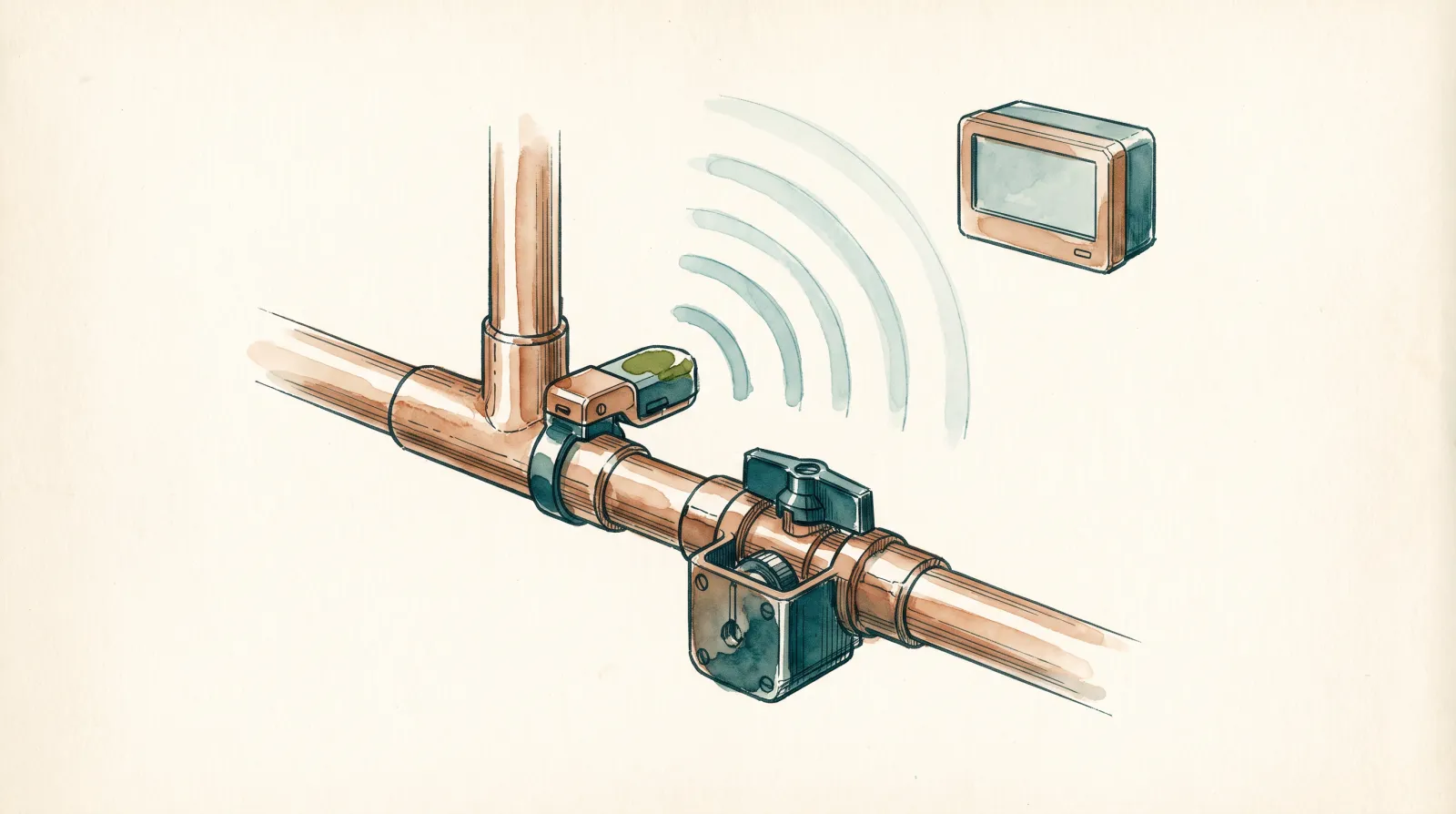
Whole-home leak detection with an automatic shut-off valve. This is the device that earns the name. Fitted to the main water line where it enters the house, it learns the home's normal flow and watches for the abnormal: the continuous trickle of a running toilet, the sudden gush of a burst pipe, a tap left on. It alerts your phone and, on the models that include a motorised valve, can close the main automatically before a slow leak becomes a soaked wall or a burst floods the house while you are away. Leaks are one of the largest quiet wastes of water in a home, and a slow, barely visible toilet leak alone can waste thousands of litres a year;1 catching them in hours rather than at the next quarterly bill is the single biggest thing this technology does.
Point leak and flood sensors. Cheap wireless pucks placed where water first appears when something fails: under sinks, behind the dishwasher, beside the hot water unit, in the laundry, at a sump. They sound and send an alert the moment they feel moisture. They do not stop the water, but they buy you the time that turns a leak into a wipe-up rather than a repair.
Usage monitoring and smart meters. A meter or clip-on flow monitor that shows consumption in real time turns water from an invisible quarterly number into something you can see. Its quiet superpower is the overnight baseline: a house that is using water at 3am when everyone is asleep has a leak, and a monitor catches that automatically. Some apartments are already fitted with smart metering displays that give residents live water, gas and electricity readings.2 The manual version costs nothing: photograph the meter before bed and again in the morning, and any movement with nothing running is a leak.
Sump and stormwater-pit monitors. For a flood-prone home, a level sensor on a sump pump with a battery backup and a high-water alert is the piece of smart drainage that most resembles the municipal version, at a scale that makes sense: it warns you when the pump is losing the fight, ideally before the water reaches the floor.
Smart irrigation. Outside, soil-moisture sensors and a rain cut-off let a garden water only when it needs it, which is where a lot of household water quietly goes.2 It is drainage adjacent rather than drainage proper, but it belongs on any honest list of smart water spending that actually pays back.
Every device here monitors or responds. None of them repairs a pipe or clears a blocked drain. A sensor that tells you a joint is weeping is worth having; it is not a substitute for fixing the joint. Treat smart water gear as an early-warning layer over sound plumbing, never as a replacement for it.
The honest caveats
Three things are worth knowing before you buy.
First, the line between DIY and licensed work. A battery sensor you place under a sink is yours to fit. A shut-off valve plumbed into the main water line, or anything that touches backflow prevention or the drainage system, is licensed plumbing work in Australia, and for good reason: it sits on the pipe that protects the whole house. Buy the device by all means; have the plumbed part installed by a licensed plumber.
Second, dependence. A device that needs the cloud, wifi and mains power is at its least reliable in exactly the moment it matters, during a storm or an outage. The better products alert locally and fail safe (a valve that stays usable, a sensor with its own battery), and it is worth checking which kind you are buying before you rely on it.
Third, the water in the drain during a real flood. No home sensor beats hydrology. When the ground is saturated and stormwater is rising, the honest advice is unchanged: move what matters above the water, never enter floodwater, and call the SES on 132 500 for flood and storm emergencies.3
Smart, honestly
The genuinely intelligent thing a home can do about its water is unglamorous: notice problems early and act on them before they compound. A leak caught in an hour, a valve that closes on a burst, a sump alert before the floor floods, these are the real wins, and they are also the eco win, because the fastest water saving in most houses is simply not wasting it through a fault nobody noticed. The city-scale sensor network is a fine thing; your version of it is a short list of good devices on a sound system. And the drain side of that system is still best read the old-fashioned way, with a periodic camera inspection rather than a permanent sensor in the pipe.
Weighing up leak detection or a shut-off valve, or not sure what your home actually needs? Tell us what you are considering and we will give you a straight read.
Sources
- YourHome: Reducing water use, Australian Government. Sets out how easily leaks go unnoticed, the overnight meter-reading test for finding them, and the scale of water a slow leak can waste, the case for early leak detection.
- YourHome: Connected home, Australian Government. Describes smart and connected home devices, including real-time metering displays for water and soil-moisture sensors that adjust watering, the honest baseline for what "smart" means at home.
- NSW State Emergency Service. Where flood risk is real, no sensor replaces the SES: 132 500 for storm and flood help, in every state and territory.