How temperature fluctuations affect pipe integrity
Temperature almost never attacks a pipe directly. It moves the pipe, and it is the movement, repeated thousands of times, that opens a crack or works a joint loose. Here is what actually happens, and which of it is worth worrying about in an Australian home.
Published 7 May 2024 · Reading time approx. 8 min
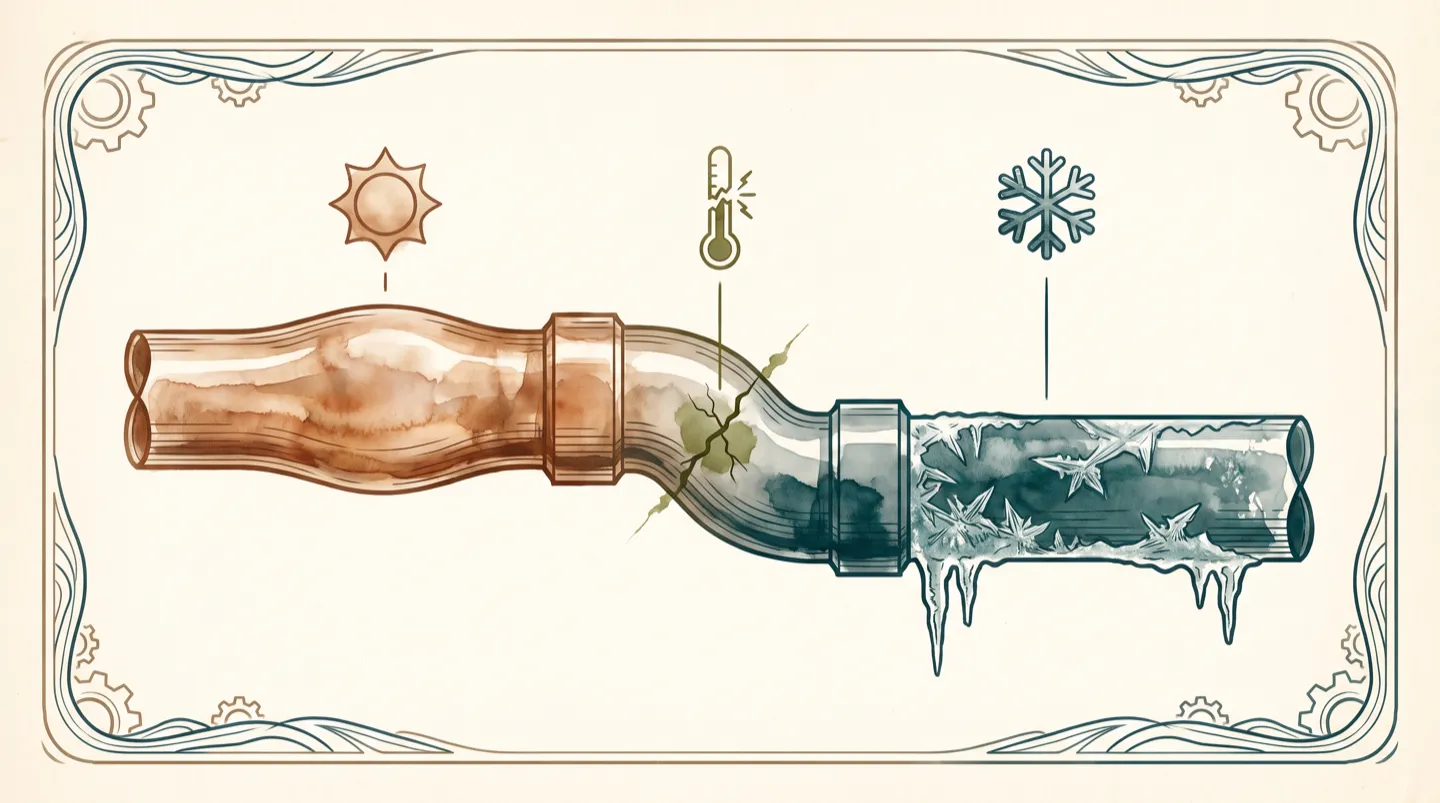
People search this question after finding a leak they cannot explain: the plumbing was fine, nothing was touched, and then a pipe let go. Temperature is often the hidden reason, but not in the dramatic way it is usually described. A pipe does not "weaken from the heat" as a vague process. Four specific, physical things happen, and if you know which one you are looking at, you know whether it is a benign noise or the early sign of a burst.
1. Expansion and contraction: the everyday mechanism
Every material grows a little when it warms and shrinks when it cools. In plumbing this matters most on hot-water lines, which cycle from cool to around 60 degrees and back several times a day. The amount of movement depends heavily on the material. Copper moves relatively little; rigid plastics such as PVC and the PVC-based pipes used indoors move roughly three to five times as much for the same temperature change; flexible PEX moves more again but absorbs it by flexing rather than pushing on its fixings.
On a short run you never notice this. Over a long straight run, or anywhere the pipe is clamped hard against a joist or passes through a tight hole in a stud, the expansion has nowhere to go and loads up at that fixed point. That is the ticking or knocking you hear in the walls a minute after someone runs a hot shower: the pipe sliding and catching as it grows. On its own the noise is harmless. The problem is the long game. The same joint being nudged a fraction every cycle, for years, is classic metal fatigue, and it is why a solder joint or a threaded fitting on a hot line can finally seep or split with no other cause. This is exactly why the plumbing standard requires hot-water pipework to be installed with provision for thermal movement, using expansion loops, offsets and the right clips, rather than pinned rigidly end to end.
Ticking or knocking pipes when hot water runs are almost always thermal movement, and by themselves are not a fault. They become worth acting on if a fixing has clearly come loose, if the noise is new and getting louder, or if you find any dampness near a hot-water joint.
2. Freeze and thaw: real, but regional
Water is one of the few substances that expands when it freezes, by close to nine per cent. If water in a closed length of pipe freezes solid, that expansion has nowhere to escape, pressure builds against the ice plug, and the pipe or, more often, a fitting or a tap splits. The split frequently does not leak until the thaw, which is why a burst so often appears on the first mild morning after a cold snap rather than during the freeze itself.
The honest Australian framing matters here, because most freeze-and-burst advice is written for northern-hemisphere winters. Along the coast and across the warm north, a hard enough freeze to burst a protected pipe is rare. In the alpine areas, the tablelands, Canberra and much of cold inland Australia it is a genuine annual risk, and the pipes that go are the exposed ones: outdoor taps, pipes in an unheated subfloor or an exposed wall cavity, and anything running through an uninsulated roof space. Lagging those exposed sections with foam pipe insulation before winter is inexpensive, is treated as basic maintenance rather than licensed work in most places, and is the single most effective thing a homeowner in a cold-climate area can do.
Before winter, insulate exposed outdoor and subfloor pipes and outdoor taps with slip-on foam lagging, and disconnect and drain garden hoses so water is not trapped against an outside tap overnight. This is preventive maintenance, not a repair. Once a pipe has actually burst, the repair itself is a licensed job.
3. Heat, corrosion and "sweating" pipes
Temperature also changes how fast a pipe ages chemically. Warmer water speeds up corrosion reactions, so hot-water lines and the fittings on them tend to corrode and scale faster than the cold lines beside them. This is one reason a hot-water system and its immediate pipework usually reach the end of their life before the cold-water plumbing does, and why the material a pipe is made from has to suit the temperature it carries; cold-rated plastic pipe on a hot line is a genuine failure waiting to happen, and getting that right is part of what a licensed plumber signs off.
There is also a temperature effect that looks like a leak but is not. On a warm, humid day, cold-water pipes run below the dew point of the surrounding air and water condenses on the outside, exactly as it does on a cold glass. This "sweating" drips, wets the surface below, and rusts brackets and fixings over time. People regularly mistake it for a pinhole leak. The tell is that the pipe is cold, the water is on the outside only, and it appears in muggy weather rather than when a fixture is used. The fix is insulation to keep the pipe surface above dew point, not a repair to the pipe.
4. Seasonal ground movement: the buried version
The most damaging temperature-linked effect on buried pipes is not the temperature of the water at all; it is the seasonal wetting and drying of the soil around them. Much of Australia sits on reactive clay soils that swell when they are wet in the cooler months and shrink as they dry out over summer, a movement that the residential footing standard AS 2870 classes and designs slabs to cope with. Buried drainage and supply pipes get dragged through the same cycle. Over years the ground lifts and drops around a rigid pipe, loads its joints, and can crack it or pull a joint apart, most often at a bend or a junction where movement concentrates.
The signature of this, as opposed to a one-off failure, is a pipe that cracks or blocks repeatedly in the same buried spot: the ground keeps moving, so a rigid patch keeps failing. The durable answer is usually a section replaced in a material and with joints that tolerate movement, or relined; either way it is buried drainage work and squarely a licensed plumber's job.
This entry sits under our guide to broken and burst pipes, which covers pipe materials, corrosion, hidden leaks and what to do in the first minutes of a burst in more detail.
If a pipe has failed and you cannot see why, or the same buried run keeps cracking, the pattern usually tells the story. Describe what you are seeing, and when it happens, at our enquiry desk and we will help you read it and point you to a sensible next step. Repairs to pressurised and buried pipework in Australia must be carried out by a licensed plumber.
Sources
- Hot water, Your Home (Australian Government). Supports the points on hot-water pipe temperatures, the value of insulating pipework, and why hot-water lines are worked harder by heat than cold lines.
- National Construction Code, Australian Building Codes Board. Plumbing and drainage work is regulated licensed work under the Plumbing Code of Australia, which applies AS/NZS 3500; that standard requires hot-water pipework to be installed with provision for thermal expansion and contraction.
- AS 2870 (Residential slabs and footings), Standards Australia. Classifies reactive clay sites by how much the ground swells and shrinks with seasonal moisture change; the same seasonal ground movement that footings are designed for also loads and cracks buried pipes.